Showing posts with label film. Show all posts
Monday, October 15, 2012
NYFF 2012: The Case for Cinema
Cinema, as an art, is not a modern human innovation. It is not an invention. The technical means by which we conceive and project it have emerged in the last century, true, but the need for it and desire for its magic has existed since the dawn of man. Some thirty-odd millennia-old cave drawings from our earliest ancestors show buffalo with many legs, presumably to create the illusion of movement of a stampeding herd when torches of light were swayed over the pictures from side to side. In 2012, it has been proclaimed that cinema is dead. Film stock is being phased out in favor of digital cameras, which some think of as little more than small computers. It is possible now to watch Lawrence of Arabia on your smartphone. Movie theater attendance has dwindled since the onset of remote controls and VCRs.
As the 50th New York Film Festival draws to a close tonight, it’s proven to be an unqualified success. Not just in terms of the publicity gained by unveiling Oscar hopefuls like Lincoln or Flight, but in showcasing a selection of films that, in 2012, actually push the boundaries of cinematic possibility and offer an exciting and hopeful future.
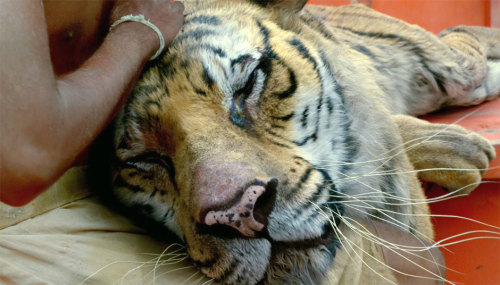
The festival opened with Ang Lee’s Life of Pi, the director’s most daring venture yet — dipping his toes in 3D technology and heavy CGI amidst the thematic density of Yann Martel’s novel. The business of Hollywood seems to have appropriated such technologies in a depressingly cynical way, going so far as to retrofit 3D onto films that were made to be seen in simply two dimensions just for the sake of maximizing their profits. But Ang Lee shows us the true potential of cinematic expression possible with these new means of filmmaking. As a spectacle, Life of Pi is unmatched. The height of the film is in the turning point of the ship sinking scene, which is equally harrowing and horrifying. The film swept me up and immersed me in a theatrical experience that I could feel would be remembered fondly in 10, 15, 20 years and forward as a moment of moviegoing marvel.
It’s what one might call an “event” film, the kind Hollywood executives try to put out each Summer to keep people wanting to see films in the theater rather than illegally streaming it to their laptop through the allure of 3D and/or IMAX projection. It’s the thrill of watching Paul Thomas Anderson’s The Master in 70mm and feeling like you’re watching a cinema in its purest form. But no director heretofore — not James Cameron, not Chris Nolan, not even Martin Scorsese — has felt out the potential for depth and spectacle with these tools more comprehensively that Ang Lee has here, not only advancing CG technology to new heights with the creation of the tiger but in cracking open new possibility for the future of film going into a digital age.
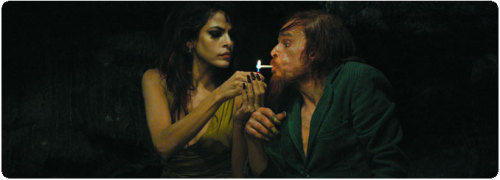
Also playing with the digital format, albeit begrudgingly, was Leos Carax’s return to filmmaking since Pola X in the 90s. Holy Motors opens with Carax himself awaking and entering a theater full of spectators as we enter his strange abstract world of a man with many worlds himself, a job of many occupations, and no shortage of faces to put on. It plays largely like a lament of this new age, between people’s abilities to be anyone they please through internet anonymity to intercuts of very early film yearning for a time when cameras were bigger than you (when now they’re smaller than your head, and everywhere you turn). Consistently mind-ripping sequences offer a feeling that they’re instantly iconic, tearing to shreds every standard of film you assume and creating a mad, nonsensical masterwork that keeps you at the edge of your seat for watching something exciting and new unfold in front of you. Sequences played out with a sense they’d instantly become iconic. You come to the safe conclusion that you never know what’s going to happen next, which is a feeling so fresh and so thrilling — to know you’re witness to a game changer. Jean-Luc Godard once noted that if cinema had never been invented, Nicholas Ray would have invented it. Suffice to say, I think the very same applies to Carax.
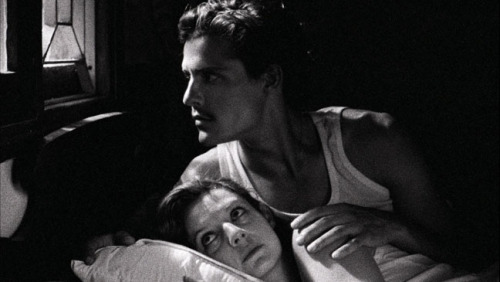
Perhaps the very finest film to screen at the festival was Miguel Gomes’ dreamily lovely Tabu. Gomes, working with film, actually uses the older tools at his disposal to paint a portrait of Western humanity between past and present, switching between 35mm and 16mm between the film’s two acts. The film in the present is in the more realistic (though black and white) 35mm print focusing on a present day woman in Lisbon whose elderly neighbor is nearing the end of her life with a maid hired by her daughter that she is deeply paranoid of. The film touches on social contexts explored in the second half of the woman’s earlier life in a Portuguese colony in Africa in grainy 16mm offering a dream-like reflection of a story that delves into unabashed melodrama that reflects on the past, its relevance to the present, and the general universality of human emotion. It works as engrossing entertainment as well as it does in its depths of commentary (pertaining to race, class, history, gender, age, etc.) and is a real achievement.
Also employing some old school film stock is Pablo Lorrain’s No, which looks like a 1980s home video cassette recording that Lorrain then brilliantly intercuts with actual archival footage looking very much the same. Documenting the “No” campaign in the 1988 Chilean plebiscite against General Pinochet, the film uses the actual television spots run on both sides and footage of protests that show the brutality of Pinochet’s regime — making so much more powerful the actual staged events of the film featuring a fine performance by Gael Garcia Bernal. The film’s fresh and fascinating use of cinema lends to a much more explicitly political message than that of Tabu, but the film is similarly so light-hearted and rather fun around its edges.
The films at this year’s festival ranged widely in genre, tone, style; some used digital, some used film. But they all unite in confirming the hope for the future of film — for its possibilities, its potential, its usefulness, and the value of still going to see movies like this in going forward. Many people seem confuse a lack of a clear future path with having no future at all. What is actually the case is something a lot more exciting, and a lot more fascinating than the more foreseeable path! People can make films at the palms of their hands and upload them to youtube. Amateurs like myself could access these works publicly and write up my own critiques of them. It can be argued, in fact, that we’re witnessing the dawn of a new emerging golden age of film. A golden age where everyday people from all around the world are creating new and interesting works of art with new and rapidly advancing formats and technologies that bring us well past the age of waving fire-lit torches across a simple painting to mimic the basic magic of a moving image, and into the 21st century with an evolving and expanding understanding of the cinematic form. Read more!
Labels:
ang lee,
cinema,
film,
gael garcia bernal,
holy motors,
leos carax,
life of pi,
miguel gomes,
new york film festival,
no,
NYFF,
pablo lorrain,
tabu
Thursday, April 19, 2012
Month early Cannes predictions
Palme D'or: Reality by Matteo Garrone
Grand Prix: Beyond the Hills by Cristian Mungiu
Jury Prize: Après la bataille by Yousry Nasrallah
Best Director: David Cronenberg for Cosmopolis
Best Actor: Tadashi Okuno for Like Someone in Love
Best Actress: Marion Cotillard for Rust and Bone
Best Screenplay: Mike Nichols for Mud
FIRPRESCI Prize: Amour by Michael Haneke
Let's see how this compares with my predictions closer to it, and how it actually unfolds. Read more!
Grand Prix: Beyond the Hills by Cristian Mungiu
Jury Prize: Après la bataille by Yousry Nasrallah
Best Director: David Cronenberg for Cosmopolis
Best Actor: Tadashi Okuno for Like Someone in Love
Best Actress: Marion Cotillard for Rust and Bone
Best Screenplay: Mike Nichols for Mud
FIRPRESCI Prize: Amour by Michael Haneke
Let's see how this compares with my predictions closer to it, and how it actually unfolds. Read more!
Labels:
cannes film festival,
david cronenberg,
film,
marion cotillard
Sunday, January 29, 2012
A Love Letter
The night that Michel Hazanavicius wrapped up the race with a DGA win, I found myself rewatching The Artist for the first time since I'd first seen it at the New York Film Festival in around October. I had never minded it sweeping the awards, and it was never quite my first choice but I always admired it and found it to be perfectly pleasant and clever.
But such may have been short selling it, I believe. Mark Harris jokes that the film has been labeled one of nostalgia falsely considering most of us were not around for the era the film chronicles, thus we can't feel nostalgic about it. But I rewatched it just feeling nostalgic for having watched it the first time a few months ago, and nearly every image was memorable in a way you just don't find with cinema these days. The Artist will be a film forever remembered as a classic precisely because of that — because you can say, "oh, remember that scene in the film?" with nearly every scene and it'll be clear and crisp in your mind as the day you'd first seen it, whether you realize it or not, the same way you can with so many gems of the most classic Hollywood films. Hazanavicius deserves full credit for expressing this story through such salient, memorable images throughout the film.
It's very much a cinematic picture in it's own right — it wouldn't even be fair to call it a period piece, since I believe the film doesn't actually take place in a real world. It takes place within the realm and universe of a silent film from that era, its characters are characters themselves from the kind of movies from that time, and more than just sheer cute gimmick, it is such a passionate homage to those films and a beautiful love letter.
It's no wonder, then, that this will almost certainly be the most deserving Best Picture winner, in my mind, since Slumdog Millionaire a few years ago. Like The Artist, Slumdog was a love letter to the Indian culture and likewise, brilliantly, infused elements far and wide from it ranging from the country's booming rise in globalized industry and development to the very conventions and sentimentality in the films of Bollywood that so many of the impoverished populations escape into with joy, dancing, sadness, redemption, morality, and more. Audiences fell for Slumdog Millionaire for the same reason they'd fall for any Bollywood film as so many now love and will come to love The Artist for the same reason classic Hollywood films came to define our culture in the past century. Read more!
Thursday, December 1, 2011
The Timeliness of War Horse
To judge a year in cinematic terms is easier to do some years than others, but in particularly strong years one can see strong trends in thematic elements explored throughout some of the more popular films of the year that reflect a certain air in the zeitgeist. As the Bush era was drawing to a close, darker fare like No Country for Old Men or There Will Be Blood were among the first names out of the lips of those familiar with the cinematic atmosphere of 2007. Entering the Obama age, an uptick in hopefulness brought about films like Slumdog Millionaire dominating the filmic discourse. Whatever this says about our current place in the annals of history this year — disillusionment with the social climate, a yearning for a better time — the trend as of late has dealt with strong feelings of nostalgia, revisiting your past, even confronting your new future. One could have seen this last year in 2010 between an emotionally awkward youth reshaping the social landscape at the costs of leaving behind those who simply couldn't keep up (Eduardo Saverin and the Winklevii) with the new era in The Social Network or a British monarch who needed serious help in adapting to the new technology of radio to keep his country together as war loomed in The King's Speech. More notably this year is how much those themes and sentiments have been vocalized so clearly in such a plethora of the very defining films of this year.
Terrence Malick's magnum opus The Tree of Life, arguably the most aesthetically significant cinematic event of the new millennium, juxtaposes at once the reflection of suburban childhood in the 1950s with the prehistoric past of the Earth to dwarf its significance in the longer scheme of its epochs of the past heading into future millennia. Owen Wilson's character in Allen's Midnight in Paris literally finds himself able to go back in time to his favorite era only to find there the same weariness of their own times. Nicolas Winding Refn's Drive mimics the flashy stylings of 80s action flicks with a sense of slowly churning dark dread underpinning the action sequences (not unlike the 1980-set No Country for Old Men) the same way Michel Hazanavicius' The Artist harkens back to Hollywood in the silent era as unwilling stars from the time watch it transition to sound. The introduction of the new technology resonates with those in the industry as it clearly parallels contemporary Hollywood as 3D increasingly finds profitability in the marketplace, as evidenced by Martin Scorsese's utilization of the newly expressive potential the technology adds to the cinematic language in Hugo, a film in which film pioneer Georges Méliès himself stops shying away from his past in the film industry and acknowledges just how forward he pushed the new medium in his own time.
What positions this year as a landmark in Steven Spielberg's career is how his two films this year places into the conversation in very similar means. The Adventures of Tin Tin uses a 3D motion capture technology on the surface but is still said to flow with the very cinematically adventurous gusto that defined Spielberg's career in the first half of his career with films like the Indiana Jones series. War Horse, however, is singularly as definitive of Spielberg's abilities and career as anything he's ever made. John William's swelling score awaits viewers of this film at every turn as a backdrop to Janusz Kaminski's lensing each shot in the vein of films like The Searchers or Gone with the Wind, among others. Nothing in the film is left unsaid, nothing is made unclear, parts of it as as sweet as the most cinematically sugary entries in his canon as the scenes of World War I trench warfare seem as brutal and viscerally trying as the storming of Normandy he chronicled in Saving Private Ryan. As he operates on this film full throttle firing on every cylinder in the most Spielbergian sense, it either works for you or it doesn't. For me I was much more easily able to look pass the emotional obviousness of some of the scenes, the predictability and the clear need to suspend disbelief at certain points because the rest of the film simply worked. The score that informed every emotion you were meant to feel, each reaction shot as a close-up allowing the talented group of actors little in way of subtle emotional expression, something about it still just managed to keep me tuned in and enjoy the ride at every turn.
If this kind of thing has never worked for you in a Spielberg film, though, it's not going to now. That reason being that the main functionality of War Horse in the cinematic conversation, what feels like the central purpose in every bone of its being, is how it harkens back to its own artistic voices behind the film at their peak in the same way that Drive does to 80s action films or The Artist does to the silent studio films and, in fact, this did somewhat to the quintessential American films of John Ford in spite of its strictly European settings (but not entirely unlike how the largely French creators and cast behind The Artist approached that film with accessible contemporaneity). Maybe better and less obviously than any other film has attempted to this year, War Horse will best satisfy the nostalgic thirst clearly evident in the desires of moviegoers this year at this time by simply being closest to that thrill and classic feel of such a story told this way that seems to have been missing in the marketplace for so long. The romanticization of the landscape, the scope of the story going between Scottish farmers and German soldiers and French civilians all affected by the War, the risk and stakes apparent in trench warfare, and the very resilience of this central character you find in this strong horse and the universal sentimentality he inspires in anyone who crosses his path.
A probably drawn out opening act that establishes this horse and his young owner's borderline Equus-like obsession with him embodies the spirit of a youthful pre-World War naïveté that can reflect a spectator's fond memories of when they themselves felt that same spirit before surrounding events hardened them to the point where Peter Mullan's character as a drunken father was in the beginning bogged down by his own traumatic memories of war and a life plagued by poverty and poor luck. Exaggerated though it may be, though at a certain point exaggeration becomes the norm in a film like this, Mullan's character almost serves as the entire audience who watches all of the events in this film unfurl in a way that forever wipes away that spirit of pre-war naïveté amongst everyone else and the realization everyone seems to come to of just how cyclical the nature of these sorts of sentiments are that our moviegoing sensibilities seem to be feeling as evidenced by the strikingly similar themes in all of these films out there this year. Last year we went through being confronted by a future we were unsure how to face to a nostalgic escape to the past only to find that it's our present and, ultimately, that scary future that we must ultimately face and come to terms with. Read more!
Wednesday, November 2, 2011
FYC: Best Actress in a Leading Role
How is it over there?
How lonely is it?
Is it still glowing red at sunset?
Are the birds still singing on the way to the forest?
Can you receive the letter I dared not send?
Can I convey…
the confession I dared not make?
Will time pass and roses fade?
Now it's time to say goodbye
Like the wind that lingers and then goes,
just like shadows
To promises that never came,
to the love sealed till the end.
To the grass kissing my weary ankles
And to the tiny footsteps following me
It's time to say goodbye
Now as darkness falls
Will a candle be lit again?
Here I pray…
nobody shall cry…
and for you to know…
how deeply I loved you
The long wait in the middle of a hot summer day
An old path resembling my father's face
Even the lonesome wild flower shyly turning away
How deeply I loved
How my heart fluttered at hearing faint song
I bless you
Before crossing the black river
With my soul's last breath
I am beginning to dream…
a bright sunny morning…
again I awake blinded by the light…
and meet you…
standing by me. Read more!
Labels:
best actress,
film,
fyc,
jeong hee-yoon,
lee chang-dong,
poetry,
south korea
Monday, October 24, 2011
MOB: The Artist — Best Picture Frontrunner
I got the opportunity to watch The Artist at the New York Film Festival, but never got the opportunity to write about it. It's a film of some lightness but it's incredibly lovely; the film draws you into its concept soon enough and, in spite of occasionally dipping into the more melodramatic and maudlin near the climax of the film, the very end goes off on a booming and spirit lifting note that has a full theater cheering at the end. I saw it among cinephiles and average moviegoers alike and the opinions were pretty much the same, and judging from the critical reaction it looks like it ticks off boxes for all relevant camps.
As far as the Oscar race goes, there appear to be three films that can conceivably win the top prize at this point — Alexander Payne's Clooney led The Descendants, Spielberg's War Horse and this. Sure, Michel Hazanavicius doesn't quite have the starpower of Spielberg's name nor does lead actor Jean Dujardin carry the crowd recognition of George Clooney. That said, anytime Dujardin's glowing smile isn't on screen, you wish it was. And we see last year with Tom Hooper beating someone at career peak like David Fincher last year that directorial star power doesn't quite go all the way every time. At this point, War Horse is more of a wildcard than anything. Spielberg this year has gotten off to a fine note getting a decent reaction for The Adventures of Tin Tin which was seen as being a lot riskier in reception than the film based upon the most recent Tony winner for Best Play.
The problem with Payne is that his films don't really hold up. Sideways positively swept the critics awards in 2004 and he may find similar passion among them this year, but in the general populace his films don't exactly hold up. Sideways loses impact upon repeated viewings while something like About Schmidt or Election are praised for little else than their respective central performances. Payne also had won an Oscar for the screenplay for Sideways and does seem to be perceived as more of a writer than a director, and George Clooney had been given his own Oscar not even that long ago while going up against Oscarless actors of similar star status like Leonardo DiCaprio and Brad Pitt. Most damning for the film is the fact that, as far as the distinction vis à vis The Artist goes is that people like The Descendants...people love The Artist.
This much was evidenced by its audience win at the Hamptons Film Festival, among a few other places, since Hamptons is where many Academy members can be found trying to catch up on this year's crop of films. You might remember last year, another Harvey Weinstein vehicle, The King's Speech took that prize. The Artist missed out on the Toronto audience award that jumpstarted The King's Speech's campaign, but it has more going for it than The King's Speech, that being that it simply fits better within the framework of the more recent winners. Whether its win was balked or not by the majority of cinephilic communities, The King's Speech still may well have been the third best reviewed film nominated last year behind The Social Network and Toy Story 3, and Colin Firth had still managed to take 2 out of 3 of the central critics groups' awards; The Artist will likely inspire even more critical adulation. It has that distinguishable feature that almost certainly makes it stand out, being silent and black and white, that reminds me of Slumdog Millionaire's ascent into Best Picturedom. And while the more dramatic elements of the story remind older voters of the most traditionally pleasurable of Hollywood themes and entertainment, the story of a Hollywood star transitioning to major changes in the film industry could not be better timed with the onset of actors' fears of motion capture performance and 3D sales dominating the new industry business model. Read more!
Labels:
academy awards,
film,
George Clooney,
MOB,
oscars,
steven spielberg,
The Artist,
The Descendants,
War Horse
Wednesday, October 5, 2011
We Need To Talk About Tilda's Oscar
When we first see Tilda Swinton in We Need To Talk About Kevin, we see her swimming through a symbolic sea of red during a tomato festival where everyone's red drenched fleshes are pressing in on one another in mass chaos and her haunting body above and floating through the crowd in a sort of sacrificial ecstasy, not unlike familiar portrayals of Jesus himself or Maria Falconetti's iconic performance in The Passion of Joan of Arc.
From that point forward the film jumps back and forth through bold editing between her life in the present and her life before leading up to this point. We see her in the beginning as a young woman with soulful passion and a joyful yearning to live and experience a hopeful life. Cut to the present day and you see a haunting shell of a woman completely beat down and ground to a pulp; rock bottom, left for dead, nothing left to look forward to, in an absolute pit of despair. She seems quite pleased to imagine that if there is a God she will go straight down to hell, because, really, how much could the physical inflictions of hell effect her to the profound point where she already is in her life right now?
We follow her journey leading up to what led her to this point with a performance as bold and daring and courageous and provocative as the material lent to her. Tilda, a proud mother herself in her personal life, went forth with a brute honesty in her character's disgust for pregnancies, the violence of childbirth, and a failure to ever connect with her own child from the start before commencing a sequence of maddening and thought provoking events raising the challenging notion of the nightmare scenario of parenting — what if everything (that possibly could go wrong) goes wrong? What if you really truly just happen to bear a monster? In this psychological horror the natural questions then arise of how much that child is a reflection of her, and how much of her she sees in this monster.
Year after year goes by whence Tilda slowly destroys and dismantles and collapses her character of Eva once brimming with hopes and passions and livelihood into the woman we see in the second half until the pivotal moment of the plot finally arrives where anything she's ever known more or less wipes out. Without giving too much away, this doesn't happen until the end, but it makes us seeing her in that barren state of unimaginably lonely and painful and guilt-ridden existence in her specially subtle and layered performance in particular all the more powerful upon retrospect and demanding of repeated viewing. Read more!
Labels:
film,
lynne ramsay,
tilda swinton,
we need to talk about kevin
Monday, October 3, 2011
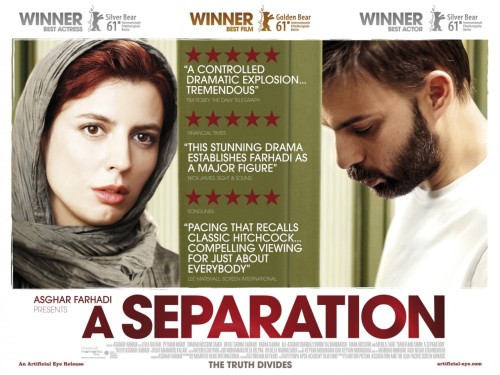
A Separation
I'm fully aware that when someone like myself has been really hyping up a certain picture for a while...and they finally see it...and it turns out, surprise!, they're in love with it, it almost seems forced if not bordering on self-fulfilling prophecy. But when Asghar Farhadi (whom I met before the screening and is a totally nice guy) introduced the film, he told us to forget anything we've heard about it and ordered us not to think about any awards it had won or what reviews we'd read of it or any preconceptions we'd held and to pretend that we have an appointment at 4:00 and were just looking for a way to kill time until then by watching that movie. And by the end of it, for the first time I've ever seen a 1 pm non-gala showing at a film festival, Farhadi rightfully received a standing ovation from the crowd.
And boy howdy did he deserve it. It was honestly one of the most emotional, invigorating, aggravating, tense and visceral viewing experiences and reaction I've had to watching a film in a very long time. Perhaps it's a bit one-sided in favor of Nader to a fault, but his character still gets enough of a vague morality that comprises part of the film's beauty. Never before, I'll say, have I seen a film that so perfectly captures the ambiguity of human "truth." Let's just say that Meryl Streep's final line in Doubt had nowhere near the impact or stakes that a similar line delivered in this film had by any means. But you see temperatures flailing as two sides held black and white and defined sides when deep inside, both sides know they each have more nuances and complications to their stories that they will refuse to confront either out of their own shame or guilt or rationality's sake to win in the system of a legal court.
There were points in the film where I easily felt as hot-tempered as the characters themselves and by the end of it was basically shaking, and I think many in the audience felt the same way. I think I read somewhere that some felt that the sort-of-twist in the final act completely ruined it for them but I don't really think it was anything that I paid much attention or mind to while watching it because it all still fit with the rest of the film and the story, and if anything added a necessary complication to a certain character's side to the story that made me sympathize a little more with her actions despite how deep the implications of it ran, whereas otherwise I think that would have seemed weak. And to me it just speaks more to how intricately and beautifully constructed every word and character and action in Farhadi's script is, and each and every performance more or less seemed as intricate and beautiful as Farhadi had seemingly written them, and I totally understand why basically every actor won Best Actor or Best Actress at Berlin and why Isabella Rosselini's jury's decision was pretty unanimous. It's truly a marvel to behold. Read more!
Friday, August 19, 2011
Best of 2011, so far:
Here we are. It's August, and as the summer season winds to a close we find ourselves headed towards festival season as the New York Film Festival announced their lineup this week. Last year I was able to see greats there like Uncle Boonmee Who Can Recall His Past Lives, Another Year, Poetry and Certified Copy with a few duds thrown in like Of Gods and Men and Aurora. More or less, however, that's when my figures by which to evaluate the "best of the year" begin to take shape. I'm still ruminating on what to catch there, although I do expect A Separation, The Artist and This Is Not a Film to all at least be the definites. I do think, though, that 2011 has been a fairly solid year so far already, and I want to use this post as a place to provide some of what I feel are the highlights thus far.

I'll start with Beginners by Mike Mills which, though well responded to, was a charming little surprise for me. Christopher Plummer may well take home an Oscar this year for playing an elderly man who comes out as gay immediately upon the death of his long-time wife and spends the short remainder of his own life trying to live the gay lifestyle deprived of him for so long. Ewan McGregor plays his son who narrates this story, who steals the show as an artist living with the pressures of his commercial work getting in the way of his desire for further expression, the sympathetic memories of his mother absent of a true husband all her adult life and keeping a girlfriend as lonely and pained as he is. His performance grounds the film in a no-nonsense realism and simplicity that balls up all these humane layers and throws it at you straight. It's fine work from all the actors involved with the help of a substantive, relatable, mature and honest script.

This summer has largely been dubbed the summer of R-rated comedies. I'm not really sure why but I guess there's been a lot of fairly successful ones released, but none quite reach the level of towering achievement as the Kristen Wiig vehicle Bridesmaids. Parts of it are equally as funny as they are painfully sad as they are harmless fun as they are simply compelling. Co-writer Kristen Wiig seemed to write herself a character that brilliantly displays her versatility in shining form, necessary for her to get past her reputation of little more than successful caricature-artist on Saturday Night Live. Her character is someone suffering through a hole of bad economic times, crushed dreams and romantic loneliness that there seems to be no foreseeable way out of. It drowns her with a deflated sense of self that's easily irritated with any further fear, envy, heartbreak or inadequacy that becomes all but guaranteed when her childhood friend asks her to be her maid of honor at her wedding. It's a tour de force of comedic performing with a better acted ensemble than, say, last year's The Fighter, more timely and resonant with the economic atmosphere than Up in the Air, more successful gross-out humor than either Hangover and funnier than any film since the last SNL star-penned script of Mean Girls by Tina Fey. It's brazenly fearless in how much emotionality Wiig throws into the story, utterly ruthless in how long she'll subject the audience to long awkward moments that are funny but leave you feeling as hopeless as necessary to connect with her central character's woes throughout the film — central to both its hilarity and its sadness.

I did a review of Paddy Considine's directorial debut Tyrannosaur a little while ago, but what's especially worth mentioning with the film now is it as a performance vehicle. To me, there seems to be no films on the horizon for the rest of the year that will be as jam packed with such a plethora of mindblowing performances. Considine in his directing and both Marsan and Mullan in their performances bring an uncanny ability to bring horrifying empathy to monsters and other monstrosities. Mullan, in particular, does wonders with so little; never falling into traps of going over the top to cheaply capitalize on melodramatic emotion nor does he underplay with an illusion of depth. What sums up how impressive his performance is can be pointed to the fact that his showiest and shoutiest moments are still shaded with many nuanced layers of subtlety and complexities that very few other actors — even those as well seasoned and as advanced in ability as Mullan — are capable of pulling off. Olivia Colman plays antithetical to the entire film and ultimately reveals a profound darkness in her purity and grace. In my opinion, she has less to do overall than Mullan but still matches him in plenty of scenes — including her "big scene," which I would bet money will remain to be the single most well acted scene of this year when everything else is all said and done.

I've already talked earlier this year on this blog about how beautiful I felt Bal is, and it remains to this day strong enough in my mind to be a worthy runner-up to talk about the best of this year, and I at least don't see it leaving a top 3 by the end of it. The cinematography is truthfully as beautiful as any film I believe that you'll ever see and encompasses everything great cinematography should be; it's beautiful but unobtrusive, it adds a layer of perspective to the storytelling and isn't just there to look pretty (looking at you, Assassination of Jesse James by the Coward Robert Ford!). And the child performance by Bora Altas at the center of it remains, in my mind, the best child performance period since Mohammad Ramezani in The Color of Paradise.

I don't think I've gotten the opportunity yet this Summer to muse on Terrence Malick's long awaited Tree of Life on this blog. To be honest, I was kind of dreading it. And I do find it very difficult to discuss, or to write about, or just to verbalize in any other way. Partly because the film is hardly wordy. It's not too rooted or concerned with plot. To its credit, it is ultimately cinematic. It is ultimately a story that could have only been told through Malick's imagery. It's themes and messages and "meanings" could only be told through the emotional interaction one has with the images on screen. It's not inherently a better form of cinema, but to me an undoubtedly purer one that's of the utmost difficulty. It's life and love and dreams and loss and sadness and greatness and family and grace and coming of age and coming to terms. It is as humane a film as you'll ever see, and Robert De Niro's jury at Cannes assured it status in the larger realm of film history, as well as the FIPRESCI group of critics naming it the best film of the past year, that it is the most important movie you'll see this year. Whether it's the best movie you'll see this year? Obviously that's up for you to decide. It's not a matter of "getting it" or "not getting it" or being purposefully pompous and pretentious versus intellectual vapidity, it's simply a matter of whether you emotionally connect with it or not. For me, I did. I let the images wash over me in what seemed to me as one of the grandest sensory visual experiences I've ever had in a cinema; and whether or not you'd like the film I would recommend the theatrical experience to anyone who possibly can make their way there. To me, it's the finest film of the year so far and will be tough to knock off the top spot. Read more!
I'll start with Beginners by Mike Mills which, though well responded to, was a charming little surprise for me. Christopher Plummer may well take home an Oscar this year for playing an elderly man who comes out as gay immediately upon the death of his long-time wife and spends the short remainder of his own life trying to live the gay lifestyle deprived of him for so long. Ewan McGregor plays his son who narrates this story, who steals the show as an artist living with the pressures of his commercial work getting in the way of his desire for further expression, the sympathetic memories of his mother absent of a true husband all her adult life and keeping a girlfriend as lonely and pained as he is. His performance grounds the film in a no-nonsense realism and simplicity that balls up all these humane layers and throws it at you straight. It's fine work from all the actors involved with the help of a substantive, relatable, mature and honest script.
This summer has largely been dubbed the summer of R-rated comedies. I'm not really sure why but I guess there's been a lot of fairly successful ones released, but none quite reach the level of towering achievement as the Kristen Wiig vehicle Bridesmaids. Parts of it are equally as funny as they are painfully sad as they are harmless fun as they are simply compelling. Co-writer Kristen Wiig seemed to write herself a character that brilliantly displays her versatility in shining form, necessary for her to get past her reputation of little more than successful caricature-artist on Saturday Night Live. Her character is someone suffering through a hole of bad economic times, crushed dreams and romantic loneliness that there seems to be no foreseeable way out of. It drowns her with a deflated sense of self that's easily irritated with any further fear, envy, heartbreak or inadequacy that becomes all but guaranteed when her childhood friend asks her to be her maid of honor at her wedding. It's a tour de force of comedic performing with a better acted ensemble than, say, last year's The Fighter, more timely and resonant with the economic atmosphere than Up in the Air, more successful gross-out humor than either Hangover and funnier than any film since the last SNL star-penned script of Mean Girls by Tina Fey. It's brazenly fearless in how much emotionality Wiig throws into the story, utterly ruthless in how long she'll subject the audience to long awkward moments that are funny but leave you feeling as hopeless as necessary to connect with her central character's woes throughout the film — central to both its hilarity and its sadness.
I did a review of Paddy Considine's directorial debut Tyrannosaur a little while ago, but what's especially worth mentioning with the film now is it as a performance vehicle. To me, there seems to be no films on the horizon for the rest of the year that will be as jam packed with such a plethora of mindblowing performances. Considine in his directing and both Marsan and Mullan in their performances bring an uncanny ability to bring horrifying empathy to monsters and other monstrosities. Mullan, in particular, does wonders with so little; never falling into traps of going over the top to cheaply capitalize on melodramatic emotion nor does he underplay with an illusion of depth. What sums up how impressive his performance is can be pointed to the fact that his showiest and shoutiest moments are still shaded with many nuanced layers of subtlety and complexities that very few other actors — even those as well seasoned and as advanced in ability as Mullan — are capable of pulling off. Olivia Colman plays antithetical to the entire film and ultimately reveals a profound darkness in her purity and grace. In my opinion, she has less to do overall than Mullan but still matches him in plenty of scenes — including her "big scene," which I would bet money will remain to be the single most well acted scene of this year when everything else is all said and done.
I've already talked earlier this year on this blog about how beautiful I felt Bal is, and it remains to this day strong enough in my mind to be a worthy runner-up to talk about the best of this year, and I at least don't see it leaving a top 3 by the end of it. The cinematography is truthfully as beautiful as any film I believe that you'll ever see and encompasses everything great cinematography should be; it's beautiful but unobtrusive, it adds a layer of perspective to the storytelling and isn't just there to look pretty (looking at you, Assassination of Jesse James by the Coward Robert Ford!). And the child performance by Bora Altas at the center of it remains, in my mind, the best child performance period since Mohammad Ramezani in The Color of Paradise.
I don't think I've gotten the opportunity yet this Summer to muse on Terrence Malick's long awaited Tree of Life on this blog. To be honest, I was kind of dreading it. And I do find it very difficult to discuss, or to write about, or just to verbalize in any other way. Partly because the film is hardly wordy. It's not too rooted or concerned with plot. To its credit, it is ultimately cinematic. It is ultimately a story that could have only been told through Malick's imagery. It's themes and messages and "meanings" could only be told through the emotional interaction one has with the images on screen. It's not inherently a better form of cinema, but to me an undoubtedly purer one that's of the utmost difficulty. It's life and love and dreams and loss and sadness and greatness and family and grace and coming of age and coming to terms. It is as humane a film as you'll ever see, and Robert De Niro's jury at Cannes assured it status in the larger realm of film history, as well as the FIPRESCI group of critics naming it the best film of the past year, that it is the most important movie you'll see this year. Whether it's the best movie you'll see this year? Obviously that's up for you to decide. It's not a matter of "getting it" or "not getting it" or being purposefully pompous and pretentious versus intellectual vapidity, it's simply a matter of whether you emotionally connect with it or not. For me, I did. I let the images wash over me in what seemed to me as one of the grandest sensory visual experiences I've ever had in a cinema; and whether or not you'd like the film I would recommend the theatrical experience to anyone who possibly can make their way there. To me, it's the finest film of the year so far and will be tough to knock off the top spot. Read more!
Thursday, July 14, 2011
MOB: NOW can we talk about Harry Potter's Oscar prospects?
Early signs indicate that it should have no problem being the single highest grossing film of the year, if not the very definitive film event of the year (financially). Critically, it's climbed to almost unanimous praise and looks pretty easily to be the best reviewed film of the Summer, if not the entire year, even not just restricting it to major releases. Read more!
Friday, May 6, 2011
Sunday, April 10, 2011
April Fool's Predictions
I know we just got over Oscar season, but keeping track of the kinds of things being predicted this early in the year does allow one to know which movies to be on the lookout for later this year and judge for yourself. It's also kind of fun just looking back at the end of it to see how wrong you were. So, let's see how wrong I'll be.
I'll only do Picture, Director, and the Acting categories. Because otherwise, naturally, I haven't the slightest clue.
Best Picture:
A Better Life
Beginners
Carnage
A Dangerous Method
The Ides of March
J. Edgar
My Week With Marylin
The Tree of Life
War Horse
Young Adult
When you think of the kinds of things that appeal to the Academy, you have to look at several factors; the pedigree of the director and how dependable their track record is in appealing to the Academy, the actors involved (actors by far making up the largest branch of voters), those behind distribution (I would not predict My Week With Marylin without the Harvey factor), and some wild guesses at the token indie slots. Last year there were two slots for movies that really embodied the indie "spirit" in The Kids Are All Right and Winter's Bone. One was a gay comedy released in the summer and the other was a quiet and somber study of a lesser represented region of this country also released in the summer in Winter's Bone. In fact, there were four movies nominated last year released in the summer — Inception and Toy Story 3 joining the two indies mentioned. Those were two significant blockbuster films, as there were two blockbuster films nominated the year before in District 9, from that Summer, and, of course, Avatar from that Winter. These predictions include three movies to be released this summer — Beginners, A Better Life, and The Tree of Life; technically all indies, but the latter with something like a $200 million budget. War Horse is another expected blockbuster to be released later in the year.
Beginners, like The Kids Are All Right, is a gay themed comedy. Of course, I'm not only predicting the movie parallel to The Kids Are All Right's nomination last year, but because of the pedigree of the actors — many people would love to see Christopher Plummer not just nominated, but winning while they still have the chance to reward the 81 year old who only just received his first nomination two years ago for The Last Station. Ewan McGregor and Mélanie Laurent have also been in films successful with the Academy before, and with an indie film like this, despite what you might think it takes away from the indie "spirit," you need actors of a certain caliber to bring it Academy attention (as The Kids Are All Right had done with the likes of Annette Bening, Julianne Moore and Mark Ruffalo). A Better Life, I compare to Winter's Bone because of what seems like its subdued nature as well as its dealings with themes of poverty (manifested through the issue of immigration in A Better Life). What convinces me to predict this, again, is not its similarities to Winter's Bone but because of Dave Karger's insistence that it's a film that should appeal to the Academy despite its low key nature. Remember, Dave Karger was at one time the ONLY pundit predicting The King's Speech to win Best Picture which, ultimately, it of course did, while The Social Network had been winning every award known to man until that point.
Meanwhile, The Tree of Life looks slated to take the spot of the summer blockbuster hit that was also critically reviewed assuming Malick does not disappoint with this film that those paying attention have been waiting years for. Another completely possible idea is for the second installment of Harry Potter and the Deathly Hallows, with good enough reviews and even better box office than expected, to take the slot with the help of tech branches trying to reward the very lucrative and iconic series as a whole. There is often, too, an animated feature that could feature in the slot as Toy Story 3 and Up have the past two years and the likes of WALL·E, Ratatouille and Finding Nemo could well have done prior. Funny thing is, those are all Pixar films, and unless Cars 2 highly exceeds the expectations set by their more underwhelming original, I don't think they'll repeat their success this year. And if they can't do it, I don't think any of the other animated films this year will, either. The other blockbuster I am predicting, however, is Steven Spielberg's War Horse. Of a grander scale than anything he's done recently, it seems as though Spielberg can make something serious when he wants to and get it Oscar nominated even though he refuses to campaign. Refusing to campaign, Schindler's List still swept the Oscars. Refusing to campaign, he still won Best Director for Saving Private Ryan. Refusing to campaign, even with lesser reviews and little talk of the possibilities, motherfucking Munich still brought him nominations for both Picture and Director. If he's serious about this, even if it's not that good, I feel like War Horse is very possible to feature in next year's Oscar show.
Going beyond that, of course, is slightly harder to prognosticate. I have My Week With Marylin featured because of an all star cast, a lot of British interest and a Harvey Weinstein endorsement. These are all the same factors evident in The King's Speech, although with less bait-inducing factors to its story (though still perfectly up the Academy's alley). That seems to check off plenty of demographics that one would have to perform strongly with to get nominated. Carnage is the upcoming Roman Polanski film based on the Pulitzer winning play with strong actors — John C. Reilly, Jodie Foster, Kate Winslet and Christoph Waltz — playing strong roles. I expect it to be highly lauded and for the actors and director to bring a lot of attention and adoration for the picture. Many seem eager for David Cronenberg to break through at the Academy Awards, as he's slowly been getting closer to all his career, and seems like it's possible with this year's A Dangerous Method — a biopic featuring Freud and Jung starring an illustrious cast including Viggo Mortensen, Keira Knightley, and Michael Fassbender (who will be in no less than five movies this year and seeming overdue for Hollywood star status after a sudden spout of several great consecutive years of performances). George Clooney also looks slated to have a banner year starring in the ever popular Alexander Payne's upcoming The Descendants, but more importantly acting and directing The Ides of March — another play adaptation with a killer cast (Ryan Gosling, Philip Seymour Hoffman, Clooney, Marisa Tomei) with thinly veiled political messages as well. If you ask me, it could be the film to get Ryan Gosling an Oscar and the whole film could go all the way as well. Clint Eastwood's been less successful with the Academy lately, but he hasn't come up with anything nearly as baity as J. Edgar in a long time with a central performance as Oscar-hungry as DiCaprio's is destined to be. Not to mention a screenplay penned by already Oscar winning Dustin Lance Black, and juicy looking supporting performances by Judi Dench and Armie Hammer. And, last but not least, Young Adult seems like it could be a continuation of Jason Reitman's stunning hot streak of Picture, Director, and performance nominations that seemed at its apex two years ago with Up in the Air.
What are some other possibilities? I'd actually look out for some foreign fare to finally break through in the top 10 with many high profile international filmmakers bringing work out this year. Consider Oscar winner Almodovar's The Skin I Inhabit this year, or Berlin winning Iranian film A Separation which, it seems — thrilling news for me — a new height reached for the Iranian film scene never before matched.
Naturally, the director nominees will come from this list. Who will be the five who stand out? In my opinion:
Best Director:
George Clooney - The Ides of March
Clint Eastwood - J. Edgar
Terrence Malick - The Tree of Life
Roman Polanski - Carnage
Steven Spielberg - War Horse
Of course, though, this list does seem a bit too "all-star." There's usually a Tom Hooper thrown in for good measure. But I'm just going with names I know they love. The director's branch is kind to actors turned directors, and everyone loves George Clooney. They just do. The Academy also loves Eastwood and Spielberg. If Malick hits Tree of Life out of the park then I don't see how he isn't nominated. As for Polanski, well, not only do they love/support him but I think they'll genuinely love the film. Also consider, however, some comedic directors in the form of Alexander Payne for The Descendants or Jason Reitman for Young Adult. Remember, Reitman even got Director nominated for Juno. Juno. Not that it wasn't one of the most refreshing choices of the past decade, but...it's Juno. Director nominated film Juno.
Best Actor in a Leading Role:
Demián Bichir - A Better Life
Leonardo DiCaprio - J. Edgar
Michael Fassbender - A Dangerous Method
Ryan Gosling - The Ides of March
Gary Oldman - Tinker, Tailor, Soldier, Spy
A Better Life is overall a bit of a gamble for me, but as I said, these categories aren't always simply all-star names. And sometimes, if a film really connects with voters, an lesser known central performer will reap the benefits as such. As I said before, DiCaprio is bloodthirsty for an Oscar, Fassbender has five films this year and I can only hope his good talents are finally recognized this year for a baity project, and Gosling looks to be working on a juicy role that he can completely nail (potentially as perfectly as he embodied Dean in Blue Valentine — high praise coming from me, mind you). Gary Oldman, however, is of the perfect age to win an Oscar and many have been astounded for two decades that the man has yet to be nominated. Going simply on technical factors, Oldman would look to be the one to beat. That said, many people are awaiting Johnny Depp (also beloved by the Academy) to even potentially win for The Rum Diaries. Although, if you ask me, the film's delay from last year to this year seems like a bad omen (apparently they didn't want him to compete with himself in The Tourist — color me skeptical). Also, as I mentioned before, if The Skin I Inhabit does well then look for Antonio Banderas to continue Bardem's tradition of nominated spanish speaking roles.
It could be my own favoritism speaking, here, but I think Peter Mullan could very well be the Javier Bardem of this year. That is to say, someone who simply gets in on the merits of their performances being that good. And, if you ask me, Mullan is even better than Bardem was. Although Bardem did have heavy Hollywood support and active campaigning from the likes of Julia Roberts. We'll see, though (he needs critics' support, although I learned last year not to trust them to reward the rightfully inspired performances).
Best Actress in a Leading Role:
Glenn Close - Albert Nobbs
Jodie Foster - Carnage
Meryl Streep - The Iron Lady
Charlize Theron - Young Adult
Michelle Williams - My Week with Marylin
First, my suspicions: this list skews particularly old. It would be a refreshing change, but the starlets always break through. It's never too young, but consider Sidibe and Mulligan '09. Consider Lawrence and Williams and Portman '10. However, this is a list I have trouble straying from. Glenn Close is consider one of the most overdue actresses for an Oscar win, ever, and in Albert Nobbs she crossdresses in World War II England. Any questions? There shouldn't be any doubt that people desperately want Meryl Streep to win a third Oscar, let alone the one Glenn Close doesn't yet have, as evidenced by her string of consecutive nominations for any vaguely caricature performance a la The Devil Wears Prada, Doubt or Julie & Julia. Each time she ran arguably in second place. Playing Margaret Thatcher, she's one I would think of as even safer for a nomination than Glenn Close (although I don't think she'll win her third until she plays a more natural, humane character a la Adaptation. which I think she can get in a few years with August: Osage County). Jodie Foster will have a very good year also directing The Beaver which, despite the Gibson factor, people seem to be enjoying. Meanwhile she's won two Oscars already and shows no sign of wain in talent, and there's no evidence that she won't give a terrific performance at the hands of the performance maestro who is Roman Polanski. And Charlie Theron would consider the Reitman tradition of nominated central performers – Ellen Page, George Clooney, and now Charlize Theron.
And then there's Michelle Williams. In my opinion, undoubtedly the most talented actress of her generation. No one her age has given a performance as good as Brokeback Mountain, or Wendy & Lucy, or (and especially) Blue Valentine. She was very shaky on getting a nomination this past year but Harvey Weinstein got her there, and much of her campaigning then was around the premise of awaiting her turn as Marylin Monroe in My Week With Marylin. Many people question whether she can simply do it — whether she can mimic the sex appeal that dripped out of Monroe. However, when Michelle Williams talked about her difficulty and how much scrutiny she put into analyzing the ways Monroe would manipulate her physicality, it seems like Williams is well aware. And, frankly, she's a talented enough actress to pull it off more than actress who may bear a superficial resemblance to Monroe. Two pictures have been released so far of Williams' role — one looked more like Marylin than the other — but the fact remains that she'll have the full force of Harvey Weinstein behind her and she is more of the mold of the standard actress winner — the younger, hotter starlet. In a biopic role. With a Weinstein-driven campaign. Not to mention, just how talented this young starlet is. It frankly reminds me of the talk Colin Firth had for The King's Speech while he was campaigning for A Single Man. And we all know how that ended up.
There is a lot to look out for, though. Look out, for example, for Elizabeth Olsen in the Sundance hit Martha Marcy May Marlene. Yes, Elizbeth Olsen, as in the younger sister of the Olsen twins who had two indie movies premiere at Sundance to stunning notice. Past starlets to have been nominated after Sundance premieres include Jennifer Lawrence, Carey Mulligan and Gabourey Sidibe. Also from Sundance is Felicity Jones from Like Crazy — which one the biggest prize (as did Winter's Bone and Precious). People are also hoping Kirstin Dunst could have a major comeback playing the usual tortured woman in a Lars Von Trier (director of Antichrist, Dancer in the Dark, Dogville, etc.) flick and be the first woman since Emily Watson in 1996 to be nominated for a Trier film.
Best Actress in a Supporting Role:
Jessica Chastain - Take Shelter
Judi Dench - My Week With Marylin
Vanessa Redgrave - Coriolanus
Marisa Tomei - The Ides of March
Kate Winslet - Carnage
Jessica Chastain looks like she'll shine in Malick's The Tree of Life, but we have to remember that Malick's never directed a nominated performance ever. She also, however, has a performance in what looks like a good (don't know about baity, though) Take Shelter. But you can interchange that performance with hers in The Tree of Life for the purposes of these predictions. Same with Judi Dench, who will also be in J. Edgar. I'm not sure which role will be more substantial, though. Vanessa Redgrave is said to be astounding in Ralph Fiennes' Iraqi update of the Shakespearean play, while Kate Winslet plays an extraordinarily difficult role in Carnage that I trust she will pull off. Consider Marisa Tomei a hunch considering just how brilliantly she plays supporting roles again and again, whether nominated or not (although in the slightest of baity films, she tends to get nominated). Mia Wasikowska has also had a highlight couple of years, however, and you can look out for her this year in Albert Nobbs as well.
Best Actor in a Supporting Role:
John Hawkes - Martha Marcy May Marlene
Viggo Mortenson - A Dangerous Method
Brad Pitt - The Tree of Life
Christopher Plummer - Beginners
Christoph Waltz - Carnage
This category is the most difficult for me to pin down. I think John Hawkes' role is one that seems tailor made for this category, and could end up being the frontrunner for the top prize after breaking through last year (Oscar-wise) with Winter's Bone. Ironically, I think Mortensen will be nominated for the role Waltz dropped out of (for which Cronenberg called Waltz a "coward") while Waltz can still very well get nominated this year for what's a lead role, really, but someone needs to go supporting! As I said, Plummer's old as hell. Meanwhile, it is a gamble to predict a Malick performance, but Pitt's going to have a busy year as well with Moneyball and this seems to be a category with room for him. Although, this is all ignoring the likes of Armie Hammer, who will be playing J. Edgar Hoover's right hand man and love interest in J. Edgar, and David Thewlis who could sneak in as an only acting nomination for Spielberg's War Horse. Read more!
Friday, March 18, 2011
March Madness: Relevant Film Updates for this year
- Roman Polanski's Carnage is slated for release this year, a year earlier than previously expected. With the cast of Jodie Foster, Kate Winslet, Christoph Waltz and John C. Reilly biting into juicy characters at Polanski's direction, this easily shoots up to one of my most awaited films of the year and possible Oscar player.
- Darren Aronofsky drops out of The Wolverine. His envisioning of the X-Men universe was one I was highly looking forward to, though not as much as the new Spider Man.
- Dave Karger, who once again proved his dominance this year as the premiere Oscar prognosticator by predicting The King's Speech all the way through — including when he was virtually the only one and mocked for doing so — senses that A Better Life will be a potential awards player at the end of the year for the film and lead actor Demián Bichir.
- Evidently, Jane Eyre is pretty good. Expect some token nominations for Costumes and Art Direction by next year.
Monday, January 17, 2011
BAFTA Awards
The British Academy of Film and Television is the British equivalence of the Oscars and Emmys rolled into one, essentially. They've had a long tradition of handing out awards, as such national Academic bodies do, but only since 1999 have they started to reward their films prior to the Oscars and have, in the years since, proven to be a crucial indicator as a precursor to the Academy Awards. They can be the deciding factors in breaking ties or deciding a very open race.
Look at 2007, for example. National treasure Julie Christie lost out on their Lead Actress prize to French darling Marion Cotillard after what had grown into a real two-way horse race (with Ellen Page as a possible upset). Marion Cotillard managed to take the Oscars. The real clusterfuck that year, however, was in the Best Supporting Actress category where Amy Ryan had been a critics darling for Gone Baby Gone, Cate Blanchett was the industry favorite after having won the Golden Globe for gender bending in I'm Not There, elderly veteran character actress Ruby Dee had won the Screen Actor's Guild prize for essentially a cameo in American Gangster and Tilda Swinton won the BAFTA for Michael Clayton. Guess who won the Oscar that year?
In Round 1 of voting, the BAFTA members release a longlist of 15 names and films per category that, in Round 2, they whittle down to 5. They denote, however, which films made the top 5 in each category except for Best Film in Round 1, which tends to mirror the final nominations about 75% of the time. The final nominations for the BAFTA should be released close to 3 a.m. EST, so I feel like I might as well attempt to predict them even though I've never done such a thing. So don't take these very seriously.
Best Film
Another Year
Black Swan
Inception
The King's Speech
The Social Network
Director
Danny Boyle, 127 Hours
Darren Aronofsky, Black Swan
Christopher Nolan, Inception
Tom Hooper, The King's Speech
David Fincher, The Social Network
Leading Actor
Colin Firth, The King's Speech
James Franco, 127 Hours
Javier Bardem, Biutiful
Jim Broadbent, Another Year
Jesse Eisenberg, The Social Network
Leading Actress
Annette Bening, The Kids Are All Right
Carey Mulligan, Never Let Me Go
Natalie Portman, Black Swan
Noomi Rapace, The Girl with the Dragon Tattoo
Tilda Swinton, I Am Love
Supporting Actor
Andrew Garfield, The Social Network
Christian Bale, The Fighter
Geoffrey Rush, The King's Speech
Mark Ruffalo, The Kids Are All Right
Pete Postlethwaite, The Town
Supporting Actress
Amy Adams, The Fighter
Helena Bonham Carter, The King's Speech
Lesley Manville, Another Year
Melissa Leo, The Fighter
Miranda Richardson, Made in Dagenham
Original Screenplay
Another Year
Black Swan
Inception
The Kids Are All Right
The King's Speech
Adapted Screenplay
127 Hours
The Ghost
The Social Network
Toy Story 3
True Grit
Animated Film
How To Train Your Dragon
The Illusionist
Toy Story 3
Original Music
127 Hours
How To Train Your Dragon
Inception
The King's Speech
The Social Network
Cinematography
Black Swan
Inception
The King's Speech
The Social Network
True Grit
Production Design
Alice in Wonderland
Black Swan
Harry Potter and the Deathly Hallows, Pt. 1
Inception
The King's Speech
Costume Design
Alice in Wonderland
Black Swan
The King's Speech
Made in Dagenham
True Grit
Editing
127 Hours
Black Swan
Inception
The King's Speech
The Social Network
Sound
127 Hours
Black Swan
Inception
Toy Story 3
True Grit
Special Visual Effects
Alice in Wonderland
Harry Potter and the Deathly Hallows, Pt. 1
Inception
Monsters
TRON: Legacy
Make up & Hair
Alice in Wonderland
Black Swan
The Girl with the Dragon Tattoo
Harry Potter and the Deathly Hallows, Pt. 1
The King's Speech Read more!
Wednesday, February 24, 2010
Greatness - "I'm Easy" from Nashville
I figure one way to keep interest in this blog thriving throughout the year when there will be no major Oscar buzz nor will there be many movies of interest for me to review, I'll just make posts of certain scenes of movie history or of anything I like, really, as those are the types of things that obviously keep fueling my own passion for film. This of course, being from Robert Altman's Nashville, from 1975. In here, everything works out. Filming is brilliantly subdued, the acting from Tomlin and Carradine is simply haunting, the song is among the most beautiful you will ever hear. It's the visceral cinematic experience in its purest sense. Read more!
Subscribe to:
Posts (Atom)