Showing posts with label reviews. Show all posts
Thursday, December 1, 2011
The Timeliness of War Horse
To judge a year in cinematic terms is easier to do some years than others, but in particularly strong years one can see strong trends in thematic elements explored throughout some of the more popular films of the year that reflect a certain air in the zeitgeist. As the Bush era was drawing to a close, darker fare like No Country for Old Men or There Will Be Blood were among the first names out of the lips of those familiar with the cinematic atmosphere of 2007. Entering the Obama age, an uptick in hopefulness brought about films like Slumdog Millionaire dominating the filmic discourse. Whatever this says about our current place in the annals of history this year — disillusionment with the social climate, a yearning for a better time — the trend as of late has dealt with strong feelings of nostalgia, revisiting your past, even confronting your new future. One could have seen this last year in 2010 between an emotionally awkward youth reshaping the social landscape at the costs of leaving behind those who simply couldn't keep up (Eduardo Saverin and the Winklevii) with the new era in The Social Network or a British monarch who needed serious help in adapting to the new technology of radio to keep his country together as war loomed in The King's Speech. More notably this year is how much those themes and sentiments have been vocalized so clearly in such a plethora of the very defining films of this year.
Terrence Malick's magnum opus The Tree of Life, arguably the most aesthetically significant cinematic event of the new millennium, juxtaposes at once the reflection of suburban childhood in the 1950s with the prehistoric past of the Earth to dwarf its significance in the longer scheme of its epochs of the past heading into future millennia. Owen Wilson's character in Allen's Midnight in Paris literally finds himself able to go back in time to his favorite era only to find there the same weariness of their own times. Nicolas Winding Refn's Drive mimics the flashy stylings of 80s action flicks with a sense of slowly churning dark dread underpinning the action sequences (not unlike the 1980-set No Country for Old Men) the same way Michel Hazanavicius' The Artist harkens back to Hollywood in the silent era as unwilling stars from the time watch it transition to sound. The introduction of the new technology resonates with those in the industry as it clearly parallels contemporary Hollywood as 3D increasingly finds profitability in the marketplace, as evidenced by Martin Scorsese's utilization of the newly expressive potential the technology adds to the cinematic language in Hugo, a film in which film pioneer Georges Méliès himself stops shying away from his past in the film industry and acknowledges just how forward he pushed the new medium in his own time.
What positions this year as a landmark in Steven Spielberg's career is how his two films this year places into the conversation in very similar means. The Adventures of Tin Tin uses a 3D motion capture technology on the surface but is still said to flow with the very cinematically adventurous gusto that defined Spielberg's career in the first half of his career with films like the Indiana Jones series. War Horse, however, is singularly as definitive of Spielberg's abilities and career as anything he's ever made. John William's swelling score awaits viewers of this film at every turn as a backdrop to Janusz Kaminski's lensing each shot in the vein of films like The Searchers or Gone with the Wind, among others. Nothing in the film is left unsaid, nothing is made unclear, parts of it as as sweet as the most cinematically sugary entries in his canon as the scenes of World War I trench warfare seem as brutal and viscerally trying as the storming of Normandy he chronicled in Saving Private Ryan. As he operates on this film full throttle firing on every cylinder in the most Spielbergian sense, it either works for you or it doesn't. For me I was much more easily able to look pass the emotional obviousness of some of the scenes, the predictability and the clear need to suspend disbelief at certain points because the rest of the film simply worked. The score that informed every emotion you were meant to feel, each reaction shot as a close-up allowing the talented group of actors little in way of subtle emotional expression, something about it still just managed to keep me tuned in and enjoy the ride at every turn.
If this kind of thing has never worked for you in a Spielberg film, though, it's not going to now. That reason being that the main functionality of War Horse in the cinematic conversation, what feels like the central purpose in every bone of its being, is how it harkens back to its own artistic voices behind the film at their peak in the same way that Drive does to 80s action films or The Artist does to the silent studio films and, in fact, this did somewhat to the quintessential American films of John Ford in spite of its strictly European settings (but not entirely unlike how the largely French creators and cast behind The Artist approached that film with accessible contemporaneity). Maybe better and less obviously than any other film has attempted to this year, War Horse will best satisfy the nostalgic thirst clearly evident in the desires of moviegoers this year at this time by simply being closest to that thrill and classic feel of such a story told this way that seems to have been missing in the marketplace for so long. The romanticization of the landscape, the scope of the story going between Scottish farmers and German soldiers and French civilians all affected by the War, the risk and stakes apparent in trench warfare, and the very resilience of this central character you find in this strong horse and the universal sentimentality he inspires in anyone who crosses his path.
A probably drawn out opening act that establishes this horse and his young owner's borderline Equus-like obsession with him embodies the spirit of a youthful pre-World War naïveté that can reflect a spectator's fond memories of when they themselves felt that same spirit before surrounding events hardened them to the point where Peter Mullan's character as a drunken father was in the beginning bogged down by his own traumatic memories of war and a life plagued by poverty and poor luck. Exaggerated though it may be, though at a certain point exaggeration becomes the norm in a film like this, Mullan's character almost serves as the entire audience who watches all of the events in this film unfurl in a way that forever wipes away that spirit of pre-war naïveté amongst everyone else and the realization everyone seems to come to of just how cyclical the nature of these sorts of sentiments are that our moviegoing sensibilities seem to be feeling as evidenced by the strikingly similar themes in all of these films out there this year. Last year we went through being confronted by a future we were unsure how to face to a nostalgic escape to the past only to find that it's our present and, ultimately, that scary future that we must ultimately face and come to terms with. Read more!
Thursday, November 17, 2011
The Descendants
At its best, The Descendants is a lovely rumination on love, loss, togetherness — in the end virtually all at once. I'd seen it in one of those bigger NYC megaplexes wishing I was back in my hometown watching it in the smaller, cozier arthouse theater that I've been watching indies like this in for years. It just has that comfortably homey quality, ya know? The perfect indie movie that you can just pop in if you're in the right mood for it and really having a great night as a result.
Unfortunately, I think a lot if it really does bog itself down too much in on itself through extraneous storylines and characters and motifs they just drag on and on unnecessarily. Mainland-centric perspectives that exoticize Hawaii have always kind of bothered me, and while I realize much of the story is trying to kind of deglam mainstream perceptions of it the constant ukelele music and random splashes of the shore you can hear and seagulls just to remind you of where it is still just stunk to me of a really smelly legacy that only snowballed until the end when George Clooney gives that incredibly patronizing and corny speech about his ancestors' lands belonging to the Hawaiian people and whatnot. I mean, I realize that's probably just adapted from the source material but I just don't think they really made it work that well, the backdrop didn't seem to add much that it couldn't have done more effectively through other means.
It might seem like nitpicking but its things like that in addition to it that just seemed tacked on and, well, tacky. The random surfer kid who didn't really need to be there, and then they just randomly force some sympathetic back story on him to show that ~everyone's more complicated than they seem~ or something. The kids in general, including the littlest one, just seemed a little too cliche and just how old farts view children and not necessarily realistic. The search for Matthew Lillard was exhaustive and annoying and boring and didn't feel worth it as a viewer by the end. And that whole subplot of trying to get rid of the land at the end, just like, blah blah blah. Give me some more Shailene Woodley man! I think she showed here that she was probably the reason why The Secret Life was such a guilty pleasure to me in the first season (until they just gave up on it and had her deliver the damn baby mid-season) because my eyes always went to her and she was constantly the most interesting person on screen to watch despite her more emotional moments sometimes seeming a bit overcooked (probably leftover Secret Life syndrome).
As for everyone else in the cast, I admittedly went in skeptical of the Clooney "career best" notices because I feel like he gets those notices every time he has a new performance and it's never, like, THAT much better than any other performance he gives — not that he plays the same character, but I think his performances are generally of the same level and not necessarily a very high one. But yeah, I do think this was definitely a role that showcased a growth and maturity in his performative abilities as a vulnerable man with a world of responsibility on his shoulders between his cousins counting on him and trying to hold his family together and dealing with the bittersweet loss of an unfaithful wife. He doesn't make my top ten or anything but I wouldn't mind him being nominated (I guess not if he wins, either, though I don't really think he's going to). Robert Forster was understated but he did shine in his brief moments, especially near the end (although the whole peeking through the cracked open door thing seemed incredibly contrived) though I don't think he deserves significant recognition for it. Nor should Judy Greer, who was fine in her...scene, but she's no Viola Davis in Doubt or anything.
I do think there's a lot of good to recommend in it, and I wouldn't mind seeing it myself if under the right circumstances...but man that last speech really lowered it for me. Like what even was that. And in general I'm not a big fan of the Alexander Payne voiceover format. Read more!
Monday, November 14, 2011
Mid-Season Report
Here I have a nifty guide with reviews of 11 films either in theaters now or coming very soon. With Oscar season going in full gear this month and you need to know what to see to catch up, look no further! Reviews of 11 films, indie or otherwise, after the cut.

Drive
Cannes Best Director winner Nicolas Winding Refn offers a cool, suave exercise in style and form in the world of 80s actions car flicks. Although many American audiences were fooled by the distributor's ad campaign for the film (exhibit a: the Michigan woman suing for the film "not being enough like The Fast and the Furious"), the white-hot intensity of the film is just as compelling in its quieter moments as its talkative moments as its action-packed, bloodied and gorey sequences. Ryan Gosling's quiet and unblinking charismatic central performance of the driver functions very much as that of a speeding car — smooth and effortlessly straight shooting throughout until the slightest motions, movements, and well judged changes leave a dramatic impact upon the viewer. Gosling's effortless emanation of cool, Nic Winding Refn's mechanical precision in his direction and probably the best soundtrack of the year as style serves the story the substance it otherwise might lack in its screenplay. Perhaps not quite the ride for everyone, but I fell right into it.
Grade: A

Hugo
An excruciating first hour of cliche, expository set-up, what ever the opposite of charisma is apparent in young leading star Asa Butterfield and boring directorial protocol eventually opens itself to any viewer willing to commit to the film up until that point to a pearl of sincere and lovely passion for the art of film, experience of cinema and history of the art as a beautiful love letter to the medium by master director Martin Scorsese. I was privileged to be at the NYFF (not so) secret world premiere unveiling of the film that will forever be remembered as Scorsese's 3D picture, Scorsese utilizes the technology as a cyclical means to position it as another step in the development of the technology sprung forth by the brilliantly innovative mind of Georges Méliés (similarly to how The Artist captures a film industry in its transition to sound, or even comparable to Midnight in Paris' yearning for nostalgia no matter at which point in history you're in). I can say it is the very first film I've yet to see that I simply can't see as anything other than the rough 3D cut in which I saw it, it eventually leans back to a convoluted and confusing conclusion wrapping up various and sometimes unrealized subplots that young audiences will likely snub at the box office this upcoming holiday season in favor of Alvin and the Chimpmunks, but it would certainly, I think, be a worthwhile and rather lovely adventure to immerse yourself in on a brisk day during the winter break catching a holiday matinee at your local cineplex.
Grade: B-

The Ides of March
George Clooney's political parable gets off to shaky footing in the first half building the premise of this tale by representing politics with high Hollywood gloss and unrealistic glamour. But perhaps that is simply the lens in which, again, youthful charismatic Ryan Gosling views his work trying to get the principled Pennsylvania governor Mike Morris (played by director/writer/producer extraordinaire Clooney) elected in an electoral environment vaguely resembling 2008's Obamania. Years of experience of manipulation, backstabbing and corruption in Paul Giamatti's Mark Penn-esque character and Philip Seymour Hoffman's Bob Shrum-esque character eventually lend their way to the decidedly darker and much more effective second half of the film that, though not necessarily making a fresh statement, completely embody the climate of disappointing disillusionment and disenchanting tainting of an ideal in one's head. Ryan Gosling shines again in his character's universal, though perhaps unprofound, emotional journey dirtying his way to stay in the political game he so believed in. The very last scene ends on the most perfect note possible.
Grade: B+

Into the Abyss
Shaking off the first few minutes of most Werner Herzog documentaries that his lovably manipulative sounding questioning of his subjects borders on self-satire at this point, Herzog examines a fascinating topic that plays right into his thematic hand. He looks at the fallout from a horrific triple homicide over a stolen vehicle in Texas in 2001 that led to a life sentence for one of those involved and a death sentence for his co-conspirator. The Death Row inmate himself should be the most fascinating window into the dark depths of humanity Herzog is so skilled in his romantic sensibilities at delving into, but Herzog never takes advantage of the opportunities in the mind of this obviously childlike but darkly twisted individual who refuses involvement with the crime to his final day (despite a lack of doubt by virtually anyone else). Everyone other than the two inmates themselves make for fascinating interviews, between the lieutenant, the family members of some of the victims and a man once in charge of dealing with Texan death row inmates on their final day who now renounces the practice. Considering the depth of potential material, in my mind still untouched in popular conversation concerning the subject, it felt like Herzog presented a fascinating and emotionally compelling first half that never paid off in the second.
Grade: C+

Like Crazy
Perhaps I'm just spoiled by the likes of films like Everyone Else, Blue Valentine, and Weekend (at the end of the list), but Like Crazy seems shockingly thin, disposable, and nonsensical in the recent independent canon of neorealistic young-doomed-romance dramas with ~vague open-ended endings~. But I was just thrilled the film ended at all. The relationship between these irritatingly immature graduate students feels rushed and inauthentic from the start, going on to the central premise of the film that offered a lot of promise in the largely ignored topic of people visiting with student visas to disappointingly sum it up to little more than an idiotic decision from Felicity Jones' character to purposefully overstay her student visa, with everyone involved fully aware of the consequences, that no one from her parents to Anton Yelchin's character as her boyfriend stopped her from doing despite brief and weak initial protests. Not that the whole theme of love making young people making stupid decisions isn't already highly overdone or anything, but these are GRAD students making PROFOUNDLY idiotic decisions that separate the viewer emotionally from their plight and should remove any sympathy for their troubles considering how easy the fix for their emotional happiness would have been in the first place (UM how about NOT violating your student visa so you'll be able to come back to the United States without that many problems in the first place?!). Films like Everyone Else and Blue Valentine allow their characters to be flawed and make poor decisions to each other at certain points that have unfortunate implications on each of their lives upon retrospect, but those were actually believable and understandable in the first place. It's like a nice sounding pop song on the radio, think Cassie's masterpiece "Me & U," that might sound nice and romantic to people on first glance but obviously, obviously, won't hold up to much emotionally substantive scrutiny.
Grade: D

Martha Marcy May Marlene
With fascinating subtlety and unsettling quietude, debut director Sean Durkin has managed to craft a mature film of the disturbing trauma of involvement with a cult without ever using the key phrase itself. Mary Kate & Ashley Olsen's eminently more talented younger sister Elizabeth goes back and forth showing a portrait of a young impressionable girl slowly roped into the world of a cult-leader played to chilling effect by John Hawkes to the aftermath dealing with a paranoia and fear that may well make it impossible for her to ever be able to comfortably assimilate back into regular society. Impressively invisible editing make you think you're descending into Olsen's convincing madness until another misjudged open-ended indie ending that, while good in premise, awkwardly punctuate the film emotionally.
Bonus: Check out John Hawkes' gorgeously haunting rendition of "Marcy's Song" via youtube.
Grade: A-

Melancholia
Said to be one of von Trier's most accessible films, which apparently simply means that it's as heavy-handed as Antichrist but simply less interesting. The film opens with highly pretentious but at least memorable imagery set to beautiful Wagnerian moaning. The first half features some lovely photography and some nice, though uneven, subtlety by Kirsten Dunst as it follows her marriage for much too long and not as well as Le Festen did in the 90s. The second story belonged more to Charlotte Gainsbourgh as the planet Melancholia (it's called that because it represents Justine's depression, get it? Get it?!) slowly beings hurling towards the Earth. Wildly uneven in tone, uninteresting in subject matter and featuring a shocking downturn in Dunst's once softly touched but now distractingly self-aware and over the top performance allows for the more talented Charlotte Gainsbourg to wipe the floor with her and offer the only fascinating and excellent part of the second half of the film (apart from the sound mix, perhaps). Spoiler alert: the world is destroyed in the end. It left a bad taste of ashes in my mouth and I unfortunately left myself wishing for more clitoral clippings and bloody discharges. Something I'd never thought I'd be missing.
Grade: C-

Paranormal Activity 3
Perhaps I'm not the greatest judge of this one. First of all, I haven't seen the first two. Secondly, I saw it with the worst audience I've ever watched a film with having watched it with my sister at home in Danbury, Connecticut (home of the "Smug Bro"). But people were literally jumping in their seats, burping out loud, holding entire conversations, loudly screaming for extended and highly unnecessary periods of time, throwing food, it was a what's-what of what not to do. And it shouldn't have affected my viewing of this film probably, but it did. Even separate from the audience experience, the film seemed to be boring up until the last scene where it made a turn, simply, for the stupid. Again, I haven't seen the first two, but I thought the creepy thing about it was that the titular paranormal activity was an unexplainable kind of ghostly force. Witches? Since when are witches scary? Am I also supposed to be screaming now at Dracula and Frankenstein?
Grade: F

Puss in Boots
Sadly not as funny as the trailer made it out to be. The slight and inexplicable movements of cats are oftentimes hilarious and had long gone unexplored comically until the character of Puss was introduced to great comedic effect in Shrek 2 and stealing the show. Antonio Banderas has been having quite a good year with this box office chart-topper and Almodovar's The Skin I Live In. There's some funny moments but none of the supporting character remotely reach the level of interest of Puss in this prequel leading up to the events at which we would come to meet this character in the second Shrek installment. Salma Hayek's...cat character thing (I don't remember her name) was really typical and lame while Zach Galianifaksadfigaefdg's Humpty Dumpty was more irritating than he's yet been on film before, and not even in the remotely funny way. But, I mean, whatever. Light entertaining fun. Not the worst thing you can be dragged to see by your children (my friend and I did note we were two of the younger viewers in our audience for this one anyways).
Grade: C

Shame
Following Steve McQueen's brilliantly revelatory first collaboration with Michael Fassbender, Hunger, McQueen does grow as an artist going in a different direction in character, subject matter and setting in this film. I don't even believe in sex addiction, personally, but the film captures the condition if it does exist seem the most convincing as they could possibly have made it. Sequences of it go on and are enchanting, and segments of Fassbender's performance are extraordinary (as well as other segments of him, ahem). Carey Mulligan comes in with a glowing supporting performance as the best she's ever been, and the two would handily deserve nominations for their bold, fresh and daring work. The film itself looks nice but doesn't have quite the visual flair that I had been hoping for based on Hunger, and I have to think of Fassbender's performance as just the slightest bit less challenging than in Hunger. And parts of it are as slow as they can be in Hunger, but again missing the visual fascination that I had with that film. But it's a strong film overall with natural moments of brilliance shining through.
Grade: A-

Take Shelter
Making an odd double feature with Martha Marcy May Marlene with confusing rumblings of the subway underneath the Angelika theater in New York confusing me at times as to what was the soundtrack and what was outside noise, Take Shelter works best as Michael Shannon's impressive descent into a hereditary schizophrenia that unravels and reveals itself throughout the film through various dreams and increasing hallucinations. He recognizes it and acknowledges it but his vulnerability still leaves him to fall victim to his paranoia as a "storm" approaches. And the tragedy of him not wanting to abandon his family the way that his family was as his mother fell into her psychosis is a very powerful notion as well. His performance is the central showcase of the film, though aided by a screenplay full of strong characters (including another top performance from Jessica Chastain) and some fantastic editing work. Unfortunately, of all the cliché open-ended indie endings this year I feel like this one is the most misjudged, making it more about the relationship with his wife (though lovely) than the more interesting psychological material apparent throughout the rest of it.
Grade: B+

Weekend
Quiet, but never boring. Artistic but never pretentious. Realistic and always believable. On one level, Andrew Haigh's take on the British indie romance this year is a seminal moment in the history of Queer Cinema as the very best film to capture the contemporary gay experience of its time since the controversial (to this day) Boys in the Band in 1970 captured the personality conflicts of a generation first coming to comfortable terms with their sexuality with a still strongly instilled legacy of guilt and confusion. On another it's simply the most romantic and realistic relationship film of the year, gay or straight. Just like with any other gay relationship, the same sex aspect of it is importantly distinct and recognized but simply not the most important part compared to the largely universal emotions at play between these two characters. Very small moments are beautifully realized and are important brush strokes on this portrait of a brief inner-city romance painted by Haigh and played by the two central actors with tender care. Tom Cullen impressively plays someone trying to naively reconcile his sexuality with a more assimilated straight culture surrounding him who calls for someone trying much more actively to express his queer identity in forms of social protest and resistance, played by Chris New. Both impressive performances working together in sync, Tom Cullen's heartbreaking revelation of his past circulated in foster homes and Chris New's slowly breaking down shell of his hard exterior can have a full room of viewers of any age or background leaving the theater and going home in tears. Beautiful, subtle and realistic retrospection makes this one of the very best films of the year.
Grade: A+ Read more!
Drive
Cannes Best Director winner Nicolas Winding Refn offers a cool, suave exercise in style and form in the world of 80s actions car flicks. Although many American audiences were fooled by the distributor's ad campaign for the film (exhibit a: the Michigan woman suing for the film "not being enough like The Fast and the Furious"), the white-hot intensity of the film is just as compelling in its quieter moments as its talkative moments as its action-packed, bloodied and gorey sequences. Ryan Gosling's quiet and unblinking charismatic central performance of the driver functions very much as that of a speeding car — smooth and effortlessly straight shooting throughout until the slightest motions, movements, and well judged changes leave a dramatic impact upon the viewer. Gosling's effortless emanation of cool, Nic Winding Refn's mechanical precision in his direction and probably the best soundtrack of the year as style serves the story the substance it otherwise might lack in its screenplay. Perhaps not quite the ride for everyone, but I fell right into it.
Grade: A
Hugo
An excruciating first hour of cliche, expository set-up, what ever the opposite of charisma is apparent in young leading star Asa Butterfield and boring directorial protocol eventually opens itself to any viewer willing to commit to the film up until that point to a pearl of sincere and lovely passion for the art of film, experience of cinema and history of the art as a beautiful love letter to the medium by master director Martin Scorsese. I was privileged to be at the NYFF (not so) secret world premiere unveiling of the film that will forever be remembered as Scorsese's 3D picture, Scorsese utilizes the technology as a cyclical means to position it as another step in the development of the technology sprung forth by the brilliantly innovative mind of Georges Méliés (similarly to how The Artist captures a film industry in its transition to sound, or even comparable to Midnight in Paris' yearning for nostalgia no matter at which point in history you're in). I can say it is the very first film I've yet to see that I simply can't see as anything other than the rough 3D cut in which I saw it, it eventually leans back to a convoluted and confusing conclusion wrapping up various and sometimes unrealized subplots that young audiences will likely snub at the box office this upcoming holiday season in favor of Alvin and the Chimpmunks, but it would certainly, I think, be a worthwhile and rather lovely adventure to immerse yourself in on a brisk day during the winter break catching a holiday matinee at your local cineplex.
Grade: B-
The Ides of March
George Clooney's political parable gets off to shaky footing in the first half building the premise of this tale by representing politics with high Hollywood gloss and unrealistic glamour. But perhaps that is simply the lens in which, again, youthful charismatic Ryan Gosling views his work trying to get the principled Pennsylvania governor Mike Morris (played by director/writer/producer extraordinaire Clooney) elected in an electoral environment vaguely resembling 2008's Obamania. Years of experience of manipulation, backstabbing and corruption in Paul Giamatti's Mark Penn-esque character and Philip Seymour Hoffman's Bob Shrum-esque character eventually lend their way to the decidedly darker and much more effective second half of the film that, though not necessarily making a fresh statement, completely embody the climate of disappointing disillusionment and disenchanting tainting of an ideal in one's head. Ryan Gosling shines again in his character's universal, though perhaps unprofound, emotional journey dirtying his way to stay in the political game he so believed in. The very last scene ends on the most perfect note possible.
Grade: B+
Into the Abyss
Shaking off the first few minutes of most Werner Herzog documentaries that his lovably manipulative sounding questioning of his subjects borders on self-satire at this point, Herzog examines a fascinating topic that plays right into his thematic hand. He looks at the fallout from a horrific triple homicide over a stolen vehicle in Texas in 2001 that led to a life sentence for one of those involved and a death sentence for his co-conspirator. The Death Row inmate himself should be the most fascinating window into the dark depths of humanity Herzog is so skilled in his romantic sensibilities at delving into, but Herzog never takes advantage of the opportunities in the mind of this obviously childlike but darkly twisted individual who refuses involvement with the crime to his final day (despite a lack of doubt by virtually anyone else). Everyone other than the two inmates themselves make for fascinating interviews, between the lieutenant, the family members of some of the victims and a man once in charge of dealing with Texan death row inmates on their final day who now renounces the practice. Considering the depth of potential material, in my mind still untouched in popular conversation concerning the subject, it felt like Herzog presented a fascinating and emotionally compelling first half that never paid off in the second.
Grade: C+
Like Crazy
Perhaps I'm just spoiled by the likes of films like Everyone Else, Blue Valentine, and Weekend (at the end of the list), but Like Crazy seems shockingly thin, disposable, and nonsensical in the recent independent canon of neorealistic young-doomed-romance dramas with ~vague open-ended endings~. But I was just thrilled the film ended at all. The relationship between these irritatingly immature graduate students feels rushed and inauthentic from the start, going on to the central premise of the film that offered a lot of promise in the largely ignored topic of people visiting with student visas to disappointingly sum it up to little more than an idiotic decision from Felicity Jones' character to purposefully overstay her student visa, with everyone involved fully aware of the consequences, that no one from her parents to Anton Yelchin's character as her boyfriend stopped her from doing despite brief and weak initial protests. Not that the whole theme of love making young people making stupid decisions isn't already highly overdone or anything, but these are GRAD students making PROFOUNDLY idiotic decisions that separate the viewer emotionally from their plight and should remove any sympathy for their troubles considering how easy the fix for their emotional happiness would have been in the first place (UM how about NOT violating your student visa so you'll be able to come back to the United States without that many problems in the first place?!). Films like Everyone Else and Blue Valentine allow their characters to be flawed and make poor decisions to each other at certain points that have unfortunate implications on each of their lives upon retrospect, but those were actually believable and understandable in the first place. It's like a nice sounding pop song on the radio, think Cassie's masterpiece "Me & U," that might sound nice and romantic to people on first glance but obviously, obviously, won't hold up to much emotionally substantive scrutiny.
Grade: D
Martha Marcy May Marlene
With fascinating subtlety and unsettling quietude, debut director Sean Durkin has managed to craft a mature film of the disturbing trauma of involvement with a cult without ever using the key phrase itself. Mary Kate & Ashley Olsen's eminently more talented younger sister Elizabeth goes back and forth showing a portrait of a young impressionable girl slowly roped into the world of a cult-leader played to chilling effect by John Hawkes to the aftermath dealing with a paranoia and fear that may well make it impossible for her to ever be able to comfortably assimilate back into regular society. Impressively invisible editing make you think you're descending into Olsen's convincing madness until another misjudged open-ended indie ending that, while good in premise, awkwardly punctuate the film emotionally.
Bonus: Check out John Hawkes' gorgeously haunting rendition of "Marcy's Song" via youtube.
Grade: A-
Melancholia
Said to be one of von Trier's most accessible films, which apparently simply means that it's as heavy-handed as Antichrist but simply less interesting. The film opens with highly pretentious but at least memorable imagery set to beautiful Wagnerian moaning. The first half features some lovely photography and some nice, though uneven, subtlety by Kirsten Dunst as it follows her marriage for much too long and not as well as Le Festen did in the 90s. The second story belonged more to Charlotte Gainsbourgh as the planet Melancholia (it's called that because it represents Justine's depression, get it? Get it?!) slowly beings hurling towards the Earth. Wildly uneven in tone, uninteresting in subject matter and featuring a shocking downturn in Dunst's once softly touched but now distractingly self-aware and over the top performance allows for the more talented Charlotte Gainsbourg to wipe the floor with her and offer the only fascinating and excellent part of the second half of the film (apart from the sound mix, perhaps). Spoiler alert: the world is destroyed in the end. It left a bad taste of ashes in my mouth and I unfortunately left myself wishing for more clitoral clippings and bloody discharges. Something I'd never thought I'd be missing.
Grade: C-
Paranormal Activity 3
Perhaps I'm not the greatest judge of this one. First of all, I haven't seen the first two. Secondly, I saw it with the worst audience I've ever watched a film with having watched it with my sister at home in Danbury, Connecticut (home of the "Smug Bro"). But people were literally jumping in their seats, burping out loud, holding entire conversations, loudly screaming for extended and highly unnecessary periods of time, throwing food, it was a what's-what of what not to do. And it shouldn't have affected my viewing of this film probably, but it did. Even separate from the audience experience, the film seemed to be boring up until the last scene where it made a turn, simply, for the stupid. Again, I haven't seen the first two, but I thought the creepy thing about it was that the titular paranormal activity was an unexplainable kind of ghostly force. Witches? Since when are witches scary? Am I also supposed to be screaming now at Dracula and Frankenstein?
Grade: F
Puss in Boots
Sadly not as funny as the trailer made it out to be. The slight and inexplicable movements of cats are oftentimes hilarious and had long gone unexplored comically until the character of Puss was introduced to great comedic effect in Shrek 2 and stealing the show. Antonio Banderas has been having quite a good year with this box office chart-topper and Almodovar's The Skin I Live In. There's some funny moments but none of the supporting character remotely reach the level of interest of Puss in this prequel leading up to the events at which we would come to meet this character in the second Shrek installment. Salma Hayek's...cat character thing (I don't remember her name) was really typical and lame while Zach Galianifaksadfigaefdg's Humpty Dumpty was more irritating than he's yet been on film before, and not even in the remotely funny way. But, I mean, whatever. Light entertaining fun. Not the worst thing you can be dragged to see by your children (my friend and I did note we were two of the younger viewers in our audience for this one anyways).
Grade: C
Shame
Following Steve McQueen's brilliantly revelatory first collaboration with Michael Fassbender, Hunger, McQueen does grow as an artist going in a different direction in character, subject matter and setting in this film. I don't even believe in sex addiction, personally, but the film captures the condition if it does exist seem the most convincing as they could possibly have made it. Sequences of it go on and are enchanting, and segments of Fassbender's performance are extraordinary (as well as other segments of him, ahem). Carey Mulligan comes in with a glowing supporting performance as the best she's ever been, and the two would handily deserve nominations for their bold, fresh and daring work. The film itself looks nice but doesn't have quite the visual flair that I had been hoping for based on Hunger, and I have to think of Fassbender's performance as just the slightest bit less challenging than in Hunger. And parts of it are as slow as they can be in Hunger, but again missing the visual fascination that I had with that film. But it's a strong film overall with natural moments of brilliance shining through.
Grade: A-
Take Shelter
Making an odd double feature with Martha Marcy May Marlene with confusing rumblings of the subway underneath the Angelika theater in New York confusing me at times as to what was the soundtrack and what was outside noise, Take Shelter works best as Michael Shannon's impressive descent into a hereditary schizophrenia that unravels and reveals itself throughout the film through various dreams and increasing hallucinations. He recognizes it and acknowledges it but his vulnerability still leaves him to fall victim to his paranoia as a "storm" approaches. And the tragedy of him not wanting to abandon his family the way that his family was as his mother fell into her psychosis is a very powerful notion as well. His performance is the central showcase of the film, though aided by a screenplay full of strong characters (including another top performance from Jessica Chastain) and some fantastic editing work. Unfortunately, of all the cliché open-ended indie endings this year I feel like this one is the most misjudged, making it more about the relationship with his wife (though lovely) than the more interesting psychological material apparent throughout the rest of it.
Grade: B+
Weekend
Quiet, but never boring. Artistic but never pretentious. Realistic and always believable. On one level, Andrew Haigh's take on the British indie romance this year is a seminal moment in the history of Queer Cinema as the very best film to capture the contemporary gay experience of its time since the controversial (to this day) Boys in the Band in 1970 captured the personality conflicts of a generation first coming to comfortable terms with their sexuality with a still strongly instilled legacy of guilt and confusion. On another it's simply the most romantic and realistic relationship film of the year, gay or straight. Just like with any other gay relationship, the same sex aspect of it is importantly distinct and recognized but simply not the most important part compared to the largely universal emotions at play between these two characters. Very small moments are beautifully realized and are important brush strokes on this portrait of a brief inner-city romance painted by Haigh and played by the two central actors with tender care. Tom Cullen impressively plays someone trying to naively reconcile his sexuality with a more assimilated straight culture surrounding him who calls for someone trying much more actively to express his queer identity in forms of social protest and resistance, played by Chris New. Both impressive performances working together in sync, Tom Cullen's heartbreaking revelation of his past circulated in foster homes and Chris New's slowly breaking down shell of his hard exterior can have a full room of viewers of any age or background leaving the theater and going home in tears. Beautiful, subtle and realistic retrospection makes this one of the very best films of the year.
Grade: A+ Read more!
Monday, October 10, 2011
My Week With Marilyn
First of all, the film itself is a lot better than I expected. Perhaps thin and a bit disposable like Me and Orson Welles a few years ago but I found this much more watchable overall and generally more convincing. It is definitely stagey and very old fashioned Hollywood in its construction but as appropriately as the film they're making in this film is very much the same.
Eddie Redmayne and Emma Watson are perfectly serviceable while Judi Dench plays the same lovable and sweet but still honest and wise old broad that she generally plays in her sleep. Julia Ormond was stunning as Vivien Leigh in her insecurities about her relationship with Olivier on the set of the film and in her starpower as she reaches 40, and I wish there were more of her since, frankly, she's barely in it.
The two stars are who you'd pretty much imagine. Now, let's get this out of the way. There were times in the film where Michelle's resemblance to Marilyn was straight up uncanny, but no, overall, she does not look all that much like her. But she didn't look more unlike her than Branagh did as Laurence Olivier in the same film. It didn't matter because at some point in the film I easily bought her as Marilyn, really capturing the full spectrum of enigma that exists in our image of her. Williams has that gift where one glance of her eyes could be of pain, disappointment, shock, overwhelming joy, flattering, etc. at different times. Your eyes go to her every moment she's onscreen, and really, I don't know any other actress who could have pulled off the performance with the same intelligence and emotional pull in spite of there being some who might just be considered more "conventionally" sexier than her (though remember, we're using our present day perception of such a thing which Monroe herself likely would not have fit).
She was excellent playing against Branagh, and it's interesting to note that Williams herself seems more of a method actress (and a very good one at that in addition to her natural beauty and allure that I think is part of the formula for the success of her performances) while Branagh is obviously more of Olivier's school. I don't know about the test screening reactions that suggest that Branagh totally outshines Williams in this; yes, he's given quite easily the very best lines of the entire movie that had me burst out cracking up in a way that I can't quite remember doing in a film in a very long time. Hits those RIGHT out of the park. But in the end it's true that Olivier's character is the actor who wants to be a star while Monroe was the star who wanted to be an actress, and her effortless starpower is what shone in this film. Read more!
Monday, October 3, 2011
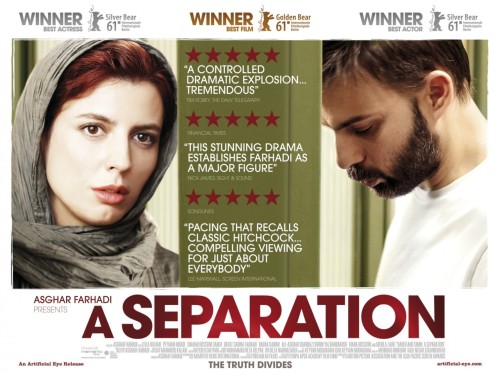
A Separation
I'm fully aware that when someone like myself has been really hyping up a certain picture for a while...and they finally see it...and it turns out, surprise!, they're in love with it, it almost seems forced if not bordering on self-fulfilling prophecy. But when Asghar Farhadi (whom I met before the screening and is a totally nice guy) introduced the film, he told us to forget anything we've heard about it and ordered us not to think about any awards it had won or what reviews we'd read of it or any preconceptions we'd held and to pretend that we have an appointment at 4:00 and were just looking for a way to kill time until then by watching that movie. And by the end of it, for the first time I've ever seen a 1 pm non-gala showing at a film festival, Farhadi rightfully received a standing ovation from the crowd.
And boy howdy did he deserve it. It was honestly one of the most emotional, invigorating, aggravating, tense and visceral viewing experiences and reaction I've had to watching a film in a very long time. Perhaps it's a bit one-sided in favor of Nader to a fault, but his character still gets enough of a vague morality that comprises part of the film's beauty. Never before, I'll say, have I seen a film that so perfectly captures the ambiguity of human "truth." Let's just say that Meryl Streep's final line in Doubt had nowhere near the impact or stakes that a similar line delivered in this film had by any means. But you see temperatures flailing as two sides held black and white and defined sides when deep inside, both sides know they each have more nuances and complications to their stories that they will refuse to confront either out of their own shame or guilt or rationality's sake to win in the system of a legal court.
There were points in the film where I easily felt as hot-tempered as the characters themselves and by the end of it was basically shaking, and I think many in the audience felt the same way. I think I read somewhere that some felt that the sort-of-twist in the final act completely ruined it for them but I don't really think it was anything that I paid much attention or mind to while watching it because it all still fit with the rest of the film and the story, and if anything added a necessary complication to a certain character's side to the story that made me sympathize a little more with her actions despite how deep the implications of it ran, whereas otherwise I think that would have seemed weak. And to me it just speaks more to how intricately and beautifully constructed every word and character and action in Farhadi's script is, and each and every performance more or less seemed as intricate and beautiful as Farhadi had seemingly written them, and I totally understand why basically every actor won Best Actor or Best Actress at Berlin and why Isabella Rosselini's jury's decision was pretty unanimous. It's truly a marvel to behold. Read more!
Wednesday, May 11, 2011
Review: Winnie the Pooh
Since John Lasseter stepped up to became the chief creative officer at Disney, you can see his influence in releasing refreshing, light and lovely children's entertainment not only monopolized by Pixar, at which he was also a big wig. Winnie the Pooh was a franchise long overdue for an uptick for today's youngest of youths, but the result in the new feature Winnie the Pooh movie doesn't come across the slightest bit as overly commercialized with money-grubbing intent. It seems made with an organic care and reverence for the original material, as close to the look and feel and conventions that worked for the series before. It's definitely nothing you haven't seen before, and doesn't do anything to break new ground. But at a solid G rating, you'd be hard pressed to find more child-friendly movie material all year. Generally, yes, it's not really for adults the way that general Pixar fare fires on all cylinders of possible demographics. It's for kids. But there is the occasional joke thrown in here and there of Spongebobian maturity to keep the parents generally entertained.
At a brisk 70 minutes, jam packed to the brim and ending on a note that never feels too soon or as if they stretched it out as far as they can, Winnie the Pooh is a tenderly crafted addition to the Pooh universe that should provide appropriate counter-programming to the major summer blockbusters of this year and perhaps leave Zooey Deschannel with a Best Song Oscar coming out of it all. Read more!

Labels:
animation,
disney,
oscars,
pixar,
pooh,
reviews,
summer,
walt disney,
winnie the pooh,
zooey deschannel
Sunday, April 3, 2011
NDNF: Tyrannosaur
There are many films that capture the bleak landscape of humanity, with an emphasis on the treatment of women, that come across as manipulative, misogynistic, forced, and/or sadistic. No such thing in Tyrannosaur. Although it doesn't deliver on the title's promise for dinosaurs, the film's tone is as vicious and ferocious as the title would suggest (including in how the title ultimately functions in the narrative). Paddy Considine's directing debut here is one of extraordinarily crisp vision, painting a portrait of a lifestyle and of a people so removed from the rest of popular society. It's a world of grit, heartbreak, pain, screams, tension, cynicism, and dogs. Perhaps the greatest testament to his work, however, which is easily believed considering his own celebrated acting career, is the delicate touch he has with his already very capable performers. Peter Mullan's career is celebrated in Europe but has gone long overlooked in the United States, though I think that may change later this year with a role more meaty than he's ever sunk his teeth into before. It's a man he very easily could have overplayed, but even his scenes of emotional outburst are painted with layers of subtlety and subtext that may very well not be topped by any performance for the rest of this year. Olivia Colman equals him in many scenes and offers a glimpse into the flipside — the nightmarish world of the middle class often kept hushed, including the many secrets she holds throughout the film. She's a character who's immediately gone through more than Mullan's character at the hands of her frightening husband (Eddie Marsan, as good as he's ever been short of Happy-Go-Lucky). The ending is appropriately less bleak in offering closure to the film, yet never resolutely tying it conveniently with a bow nor offering a worldview any less pessimistic than it always had. By the end, people's lives are dirt. And no matter what you do, they're always going to be dirt. Read more!
Labels:
eddie marsan,
NDNF,
olivia colman,
paddy considine,
peter mullan,
reviews,
tyrannosaur
NDNF: Margin Call
J.C. Chandor's feature debut Margin Call is a fresh, razor sharp and timely film acted effortlessly by a strong ensemble cast. It paints the clearest portrait of our economic climate today by not trying to dumb the concepts in ways that are still difficult to grasp, like Inside Job, but rather through getting into the mindset of those involved in such corporate meltdowns. The film is strongest in its first half, as most films are, when the banking company at the center of the film's problems are just revealed and a cast of strange characters ranging all different levels of corporate authority spend an entire night in very limited office space in what plays out as one of the most compelling thrillers you'd ever see. The film goes on, however, as the cancer spreads and the settings open up. We see these characters at their edges, at their harshest and at their most desperate. Zachary Quinto is underused in the film but still effective with his heavy glare that speaks volumes to all the different equations and thought processes going behind his character's mind as he penetrates a bizarre world of corporate elders that seems akin to Dante's Inferno. Bosses answer to other bosses who answer to other bosses that grow stranger and more powerful though with less soul as you go up the ranks until Jeremy Irons, who rules the operation with an iron fist. He hisses and bellows with authority in the Shakespearean ways he's so good at doing. Read more!
Labels:
J.C. Chandor,
Jeremy Irons,
margin call,
NDNF,
reviews,
zachary quinto
Thursday, March 10, 2011
'Bal' (Honey)
The Turkish film Bal — in English, Honey — is infused with a quiet power. The film’s rich and hauntingly soulful imagery makes it nearly impossible to do the material justice in a single review. Bal is the third film of director Semih Kaplanoğlu’s Yusuf Trilogy, which is set in the isolated Turkish countryside and focused on the young Yusuf and his parents. Shy, soft-spoken and stammering, Yusuf barely speaks in more than simple whispers to his beekeeper father, farmer mother and classmates. As Yusuf’s father’s bees disappear, so do the beautiful plants of the lush Turkish countryside; and the consequential loss of honey leads to a loss of innocence for the characters. Subtitles become superfluous as the viewer is drawn into Yusuf’s gaze: His wide brown eyes take up so much of his tiny face, his lower lip is tucked into his upper lip, and his breath comes in heaves the more emotional he gets. Kaplanoğlu’s camera lets us feel this child’s yearning, jealousy, shame and happiness. And the emotions are transmitted in the purest form of cinema. The film is strongly reminiscent of Víctor Eric's The Spirit of the Beehive, not simply for the fact that both father figures in the film are beekeepers, nor for the symbolic significance of honey in each, but rather for both Erice's and Kaplanoğlu's proficient touch at capturing the poetry in the childhood gaze. Each frame is composed with a painterly sensibility, the natural sunlight bringing out the vibrancy of every color with which Kaplanoğlu uses to most saliently evoke the most precise emotion at any given moment. Despite a deliberate pace, Bal a thing of beauty that should be considered nothing less than essential viewing when it opens on March 25th at the Village East Cinema. Read more!
Friday, February 11, 2011
Review: HaHaHa
Munkyung is a young Korean filmmaker planning on moving to Canada to live with an aunt. Few days prior to leaving, he catches up with his friend Jungshik over drinks. They swap fond stories of their recent adventures in a small seaside town without realizing how intersected their respective tales were in time, place, and people involved.
Writer/director Sangsoo Hong frames his screenplay in this friendly conversation between several rounds of drinks, painting a full portrait of groups of friends drifting through their summer in joy, sorrow, and immense self-consciousness. Hong makes sure to remind us of the subjective and probably not entirely trustworthy framing of the story by interrupting long sequences of their memories in color and motion with black and white montages of still photos showing their present conversation, with voice over of the men chatting and laughing before initiating the next segment with multiple "cheers." Clearly playing against the conventional instinct to show memory and pastness in black and white or through still photographs rather than the present, Hong gives us fascinating insight into his perspective of how memories are formed and play out more colorfully and cinematically than our present does.
More to the probable point, however, is the humanity with which these characters interact with each other. Our two narrators agree in the beginning to only reflect upon pleasant memories, but what plays out is not necessarily a rosy picture. The people we follow are not perfect — in fact, most of them can be downright irritating and unlikeable. This can make it difficult for Hong to maintain the viewer's attention throughout the film's slowly paced running time, but, with patience, the audience will be rewarded with a humane sympathy towards these characters in spite of their wallowing self-pity, aching self-consciousness and sensitivity for the simple fact that these colors only show when they interact with people they care about. It's less about the characters on their own than it is about the dynamics of the important personal relationships they keep, whether out of friendship, family, or romance.
HaHaHa is a more vérité entry in a blossoming New Wave for Korean cinema which had a very successful year at last year's Cannes Film Festival — with this film winning the Un Certain Regard prize joining the fantastic film Poetry (from the same production company, Finecut) taking screenplay honors in the main competition. Actress Sori Moon is Seongok, the strong-willed and proudly independent woman who still holds a basic need for a loving intimacy. Moon is on the younger end of the ensemble that spans a diverse group of all walks of life in age, shape and profession to give a broad spectrum of Korean life including the more middle aged Munkyung, whom she ultimately ends up with, and his mother (the old Korean mother being a central figure in many Korean films such as Mother or Poetry).
HaHaHa will have a special screening at the newly renovated Museum of the Moving Image on Sunday, February 20th at 6 p.m. as part of their "Korean Cinema Now" series with the help of The Korea Society. Read more!
Labels:
cannes,
hahaha,
international cinema,
korean cinema,
reviews
Sunday, December 5, 2010
Review: Black Swan

Vincent Cassell informs his group of New York City ballet dancers that he's going to stage the old staple of ballet, Swan Lake. But it's going to be different. It's gonna be stripped down — visceral, real.
He chooses Natalie Portman's character Nina Sayers — a shy, self-conscious and quaint figure. An ambitious dreamer. The first half of Darren Aronofsky's Black Swan kind of plays out like her character. It misses some steps trying to get the story along, a lot of it is really very obvious. No real depth. Barbara Hershey's role as Nina's mother is perfectly chilling in its own right, but she's not allowed much depth to delve into. Vincent Cassell's Tomas' sleaze is really rather one-dimensional. His humanity hardly present.
Portman, however, is already the best we've ever seen her at this point. Her physicality in her dancing is impressive enough as it is, but emotionally we see a frail young woman at the end of her string. A string of delicacy that Portman dances over like a man on wire's balancing act. A poetic portrait surrounded by light strokes, as meticulous as the perfection Sayers strives for.
Tomas needs Nina to break out of her shell. Her innocence is perfect for the White Swan in the production, but he needs her to break loose into her Black Swan. In her ambition she falls into herself into a state of insanity. Slowly she devolves until she completely lets go. Much like the film does, as well.
Much as the first half mirrors Nina Sayers' state of mind, the second half of the film perfectly reflects her descent into dark delirium and operatic madness. We see the full force of a true maestro's ferocious ambition with Aronofky's direction — we see a true vision find its wings and take flight on the screen as Sayers goes out on stage for her first performance. Every element, every shot is so necessary but flows much more freely than the first half did. Nina Sayers' transformation is truly a sight to behold.
And much of that credit is owed to one Natalie Portman, who took up the challenge and for the first time in her career seemed to transcend the bounds of performance into being. Truly immersive, if Aronofsky paints the world of madness she drags you down right in with her. You're transfixed onto her until the very last shot where you're left dumbfounded.
Countering Portman's white swan is Mila Kunis' black swan of Lily. Effortless, real, unconscious. Next to Portman, wound up like the music box with a spinning ballerina she keeps by her bedside, you really see what Tomas is referring to with Lily's free energy. She plays off of Portman incredibly effectively, and gives perhaps the best major supporting performance in the film.
Aside from Kunis the other worthwhile mention is of Winona Ryder's cameo. Aggravated with being older and washed up, we see her Beth already through Natalie Portman's hell and back many a time. She makes the most of her limited screentime by emanating a paradoxically fiery chill to her character. One who's on edge, fierce, but at the same time you could see a haunting in her. Her career has taken everything out of her, and now she's just the empty shell of a woman without it.
Aronofksy has created a truly bold piece of cinema, using every element from Libathique's kinetic camerawork to Clint Mansell's crowning achievement in the music to push the limit on what is cinematically possible. He takes a familiar story of one descending into madness through art, seen and perfected in a movie like The Red Shoes before it — but strips it down; making it intimate, real. And with it finding a mainstream audience witnessing the psychological horror before them, it looks like we could have a real game changer on our hands. Read more!
Thursday, November 18, 2010
Reviews: Blue Valentine
It took ten years for director Derek Cianfrance's vision of Blue Valentine to come to the screen. After every grueling day of filming, it is reported that Michelle Williams would scream throughout the entire car ride home from set. Though its sex scenes were relatively tame, they were still viscerally affecting enough to earn it an NC-17 rating from the MPAA — usually reserved for the most extreme of content. Though filmed in a vérité style, the film is as cinematic as it is blisteringly real. It's a film that grabs you by your throat, and refuses to let go.
Some average moviegoers will take a look at the trailer and wonder what it's about. Well, the story line is really rather simple. It's an examination of a couple, played by Ryan Gosling and Michelle Williams, jumping back and forth between past, at the start of their relationship, and present, as it crumbles apart. It's a character study, and the character is the marriage between Gosling's Dean and Williams' Cindy. It would do you an injustice for me to give away too much of the details of how the film unfolds, because a lot of the film's greatness lies in its little pieces. The details. Small and large puzzle pieces alike of this mosaic of a contemporary married couple, and you as an audience are trusted to place the pieces together as you see it and come to your own conclusions of the characters' situation.
Many of these pieces are offered by the two central performances by Gosling and Williams. Both play their parts with the honest and often unsettling realism of the rest of the film. Between the two of them, it's almost four performances you're really looking at — one for each of them in their youth as well as them slightly older. Ryan Gosling's first performance is that of a young man from a broken past who manages to remain as idealistic and joyful in his youth as he is a thick-skinned and hard worker. At his core, though, he's a man who aims to please — whether in the loving care that he took to decorate the nursing home room of the old war veteran he helped move in or the exuberance in which he romantically serenaded Cindy with his songs, and it's that natural tendency in him for love that we see remain most strongly when we shift to the present. We see how torn apart he is over the loss of the family dog, we see just how fantastic of a father he is to their daughter Frankie, and we see how devoted he is to keeping this marriage alive. On the outside, though, he carries the air of a broken man. We see the physicality in which Gosling got balder and fatter, but his ambitions have greatly lowered and he hardly sees himself getting much further in life than he is at this point. Gosling is said to have based his performance upon imitating writer/director Cianfrance, thereby offering perhaps what could be the more relatable side in the movie to more people by playing his role in the same eyes as the film is directed in.
But I would assert that just his equal is Michelle Williams as Cindy. Williams had some added difficulties in being the much less mature half in the portrayal of her character's high school years — not to mention the trauma inflicted upon her then — to being the more mature half in the present. She constantly berates Dean when simply being playful with Frankie, as she doesn't "want to have to clean up after two kids." She is faced with mounting pressures from her demanding nursing job, not to mention her home life with Dean where their marriage is very clearly on the rocks. Williams does a brilliant job filling in the gaps of what may seem like questionable judgment on the page of the script. How can she possibly let go of such a great father to her child? Why such a change of heart? How did she get so mature? How did she end up going through with keeping her baby?
Of course, I do give a lot of the credit to Ms. Williams for taking on these challenges and giving in a performance as thoughtfully well rounded and emotionally affecting as Gosling. And, by the end of the film, I did feel like I could perfectly understand both sides to their stories. In fact, possibly the greatest strength and testament to the effectiveness of their performances is how well they worked in harmony with one another (or appropriate lack thereof). Their chemistry was real, almost undeniable, and their interactions with each other carry the weight of their past experiences with one another and how central the other has been in their lives. But a lot of the credit, for all of these accomplishments, also deserves to go to the enormously accomplished screenplay. The film is really quite revolutionary, as far as I've seen, in the way it depicts real life topics like abortion and human sexuality with a frank and refreshing honesty. Whether it's Dean moaning that he deserves a little more affection or how in-your-face and truly horrifying the actual procedure of an abortion is displayed (as opposed to the "pro-life" argument framing it as an "easy way out" of sorts). The depiction of a high school pregnancy was also one shown with a refreshing honesty that neither glamorized it nor demonized it. It simply was what it was, just as everything else seen in the film, which is its strongest attribute.
And the whole thing made for cinema as compelling as it can be. And that's the thing — it is truly cinematic. The performances pulled from the actors themselves seem like enough evidence for Cianfrance's directorial breakthrough without even mentioning the performance from child actress Faith Wladyka, the best since Justin Henry in Kramer vs. Kramer. But whether it be from the crisp cinematography that could at one moment elate you as it breaks you the next, or the jump cut editing between the present and past, it is a film that truly captures the delicate balance possible between a blistering realism and truly visual cinema. There were points during the film where I had suddenly realized how literally breathless I was, and for how long. For the two hour running time of the film, I had forgotten that I had to go to the bathroom beforehand. When the two hour running time had finished, much sooner than I had expected it to, there was a palpable sense of devastation in the audience I saw it with. You could feel it. It was a knockout. Read more!
Thursday, October 21, 2010
Biutiful
Alejandro González Iñárritu's latest Biutiful tackles difficult themes of mortality and finding peace with one's self before moving on to an afterlife. The film opens and closes with some fascinating sequences. It's just everything in between, however, that is problematic.
The film is anchored by a very humane performance given by Javier Bardem, in spite of the challenge of his character's supernatural sensibilities. His Uxbal is a family man, a business man, and an ex-husband nearing the end of his life. Bardem nails each aspect of the role with a general concern for people he feels responsible for. The audience's spirit deteriorates with his as the film labors on and we watch him inch closer to the end, where he'll be reunited with the dead he'd always been able to communicate with during his life.
If the film had managed to stay more focused on his storyline, the film could potentially have turned out a very emotionally affecting piece. But in true Iñárritu fashion, he can't help but try to dilute this storyline with other interweaving character narratives that have worked so well for his films in the past. Uxbal's brother, Tito (Eduard Fernàndez), getting ready to buy their father, has sexual flings on the side with Uxbal's bipolar ex-wife Marambra (Maricel Àlvarez) who is desperate to see more of her children. Apart from Uxbal's personal troubles, his professional affairs are in a delicate state between the Chinese manufacturers he goes to for supplies of counterfeit purses, the Senegalese immigrants who sell those purses on the streets and the police force Uxbal often bribes growing impatient of these street vendors working on illegal streets.
The subplots of the Senegalese street vendors' struggling family lives and the Chinese factory owners with a labor force of illegal immigrants don't only distract from the power of the central themes, but are indicative of a larger tone of self-seriousness the film suffers from. Several shots like that of a dead owl in the snow, a pigeon walking over a lifeless homeless man, or birds en masse flying in formation over a sunset-lit sky seem perfectly poetic on their own accord, but in context often seem out of place and trying much too hard. The revelation of the two Chinese factory owners being gay is so overt and unintentionally hilarious that it trivializes their sexuality, and the screenplay's attempt of emotional manipulation falls flat on the audience. The film often deals with the question of exploitation, whether between the factory owners and their laborers or Uxbal trying to profit from their work. The film asks, "who's exploiting who?" It would seem to me that, most of all, it's the film itself.
The film has been described as "unconventional," which will be used to explain much of the negative reaction that will come from it. Fact of the matter is that that's not what's wrong with it. I found promise in the unconventional premise, and was hoping to find an unappreciated gem in this film. And there are good points to it. The larger ensemble work is strong, sudden cuts show the spirits of the dead hanging off ceilings in a deliciously creepy fashion, the camerawork is well lit and shot. All in all, though, the film is greatly uneven. The editing, usually strong in Iñárritu's work, attracts attention to how awful it is at some points including split seconds of random shots unnecessary in setting the scene. The score comes blaring in oafishly at the most bizarre moments where you’d least expect it. Many emotional tensions set up at certain points are relieved unsatisfactorily and awkwardly, and it drags on for far too long. The film is simply a mess, and a disappointingly missed opportunity.
Grade: C Read more!
Monday, September 13, 2010
I'm Still Here

I know I've been a bit delayed in wording my response to I'm Still Here, the Casey Affleck-directed documentary on his pal Joaquin Phoenix's journey announcing his retirement from acting and instead pursuing a hip hop career. I've been taking some many days to mull it over, especially considering that it's likely one of the most thematically dense movies you'll see all year. It's as comparable to the low-brow gross out comedy of Borat as it is as ponderous of a study into contemporary stardom that blurs the line of truth and fiction as Abbas Kiarostami's masterpiece Close-Up. It at once satirizes the conventions of documentary filmmaking, public scrutiny of celebrities on all fronts of contemporary media, and the reality of these actors' lives themselves. Some of the crudest scenes of comedy offer some of the ultimate visual metaphors (in one scene, in particular, Phoenix literally gets defecated upon).
Watching it with a full audience in a theater was a fascinating thought exercise in itself. People were never sure when to laugh, and then they started to laugh at every single piece, and then the film took a turn to the point where it seemed like the audience never wanted to laugh ever again. The film opens with stock footage of Phoenix in his childhood, taking a swim in a Panamanian river by a small waterfall with his father. I seemed to be the only one who found humor in how absurdly self-serious the movie made itself right off the bat, but I certainly thought the tone was meant to be ironically funny. The film goes on for a less interesting stretch of time in the beginning that sets up the premise of the film with Phoenix announcing his retirement to the press, but I suppose Affleck compensates for that in interest by showing some rarely seen extended clips of full frontal male nudity and various other shenanigans of debauchery from Phoenix's aides to hold the audience's full focus.
The one question I always get after telling people I'd seen the film was whether or not it was a hoax. The film did itself a favor around the beginning by addressing the hoax accusations reported in places from the start head-on; not only insisting that it wasn't, but incorporating the accusation as another struggle Phoenix goes through during the film in his quest to be taken seriously. In doing so, Affleck pulled off the enormous challenge of leaving a lingering possibility in the audience's mind that it could, quite possibly, be true. And in the more likely event that the scenario was largely set up, it further blurs the lines between which sequences of the film are actuality and which ones were not. This giant question mark lingering over your head throughout your viewing of the movies is further obscured and complicated leading up to Phoenix's climactic breakdown around the time of his Letterman interview, which seems all too devastatingly real in Phoenix's realizations of what he's become (namely, a joke).
No matter what your opinion on Joaquin Phoenix at this point, I think it must be acknowledged that he's nothing if not devoted. Rolling with this ostentatious characterization of himself through unimaginable odds and public scrutiny, he bravely improvised a public portrait of the pitfalls of fame and a man, mirroring himself, at his breaking point. It's a brilliant exercise and achievement in performance that's likely to remain one of my favorite male performances by year end, and just as likely to go unacknowledged by mainstream rewarding bodies.
Casey Affleck incorporates a few interesting touches to the already mind bending concepts already at play in the premise of the film — Kubrickian shots of deep focus, and a sped up encounter with groupies similar to A Clockwork Orange. A final Malickian long take of Phoenix returning to the Panamanian jungle from his childhood captured on the video footage shown at the start of the film, looking like it was lifted straight out of The Thin Red Line (personally, to me, one of the funniest scenes of the film; though the audience I was with did not seem to get the humor). An odd companion piece to another documentary from earlier in the year, Joan Rivers: A Piece of Work, also analyzing the show business lifestyle with a sense of humor. I'm Still Here clocking in at about two hours is probably too long to sustain the interest and novelty of the story, but in the end its a fascinating exercise in filmmaking and the results are a wonder to behold.
Grade: B+ Read more!
Tuesday, September 7, 2010
The American
Celebrity portrait artist Anton Corbijn started off his film career with dynamite by directing the 2007 film Control. Posing as a generic rock star biopic depicting the life of Joy Division singer Ian Curtis, the film truly plays best as a heartbreaking kitchen sink drama and the tragic character study of a young victim to stardom. Like Control, audiences might be deceived by what The American appears to be; it's not your regular high-budget Hollywood assassin thriller, but rather a slowly simmering portrait of a man living in a cold and isolated hell he has made for himself with his career. What he does requires much quiet concentration and very little visibility of himself, though the consequences of his line of work end up being both loud and noticed. Despite its title, it is born out of a clear influence of the distinctly European thrillers of the 60s (like the French Le Samouraï). Despite him posing as a photographer named Edward to Italian pedestrians, George Clooney's character is really a trained long-time assassin named Jack. Despite being a priest, Father Benedetto (Paolo Bonacelli) had fathered a bastard child in his past. The film is very dependent on the notion of things not being what you first perceive them to be, and of how deceitful perceptions (long-term or short) can really be.
The film opens with a long wide shot of the cold Swedish landscape. We hear nothing but the whistling wind to complement the piercing white of the snow highlighted with cloud-veiled sunlight. Here we find a burly bearded Jack with a woman he later describes as "a friend," vacationing in a small wooden cabin. They walk out into the snow to discover a mysterious set of footprints, those probably not of hunters because they usually travel in twos. Suddenly, the serenity is disturbed by a shootout that Jack survives. However, in the fallout, he's forced to shoot his lady friend out of fear of a setup. He's ordered to stay low for in the discreet Italian countryside while higher authorities sort out who's after him.
The opening demonstrates the tonal approach to the film, in which the quiet patience that slowly unfolds the story actually intensifies the gripping tensions in the few action scenes there are. Every shot fired leaves you breathless, working to scare you away from the violence portrayed as opposed to the stereotypical "American" film that glorifies it and appeals to you through your adrenaline level. The camerawork throughout the film, like the opening, generally tries to show you everything. Uninterrupted shots of the beautiful European locales in which the film was shot dominate some scenes, like the Swedish snow or the lusciously warm greens of the Italian countryside. Cinematographer Martin Ruhe's work here is much less flashy than his last Corbijn collaboration in the black and white Control, featuring tons of light and shadow play. Here, Ruhe trusts the natural lighting of these unbelievably beautiful places which will be tarred by the ugliness of human action set forth by the story — the concept played symbolically when the beautiful prostitute Clara (played by Violante Placido) takes a nude swim in the sparkling stream until she painfully steps on a bullet left in the water.
The few scenes of actions do actually move rather quickly and the camera and editing work is more expectedly flashier, like the nighttime shootout between Jack, another hitman, and an unexpected motorcyclist caught in the crossfire. In the end, to its credit, these scenes are less noticed and remembered than the more mannered and disciplined method applied to the rest of the film. However, at its worst, the general scheme of editing and camerawork keep the film static; going through very long stretches at a slug-like pace with little to no development. For example, we are let in pretty early on of Jack's longing for an emotional and physical connection with someone, a privilege not offered to someone of his line of work, but perhaps the film spends a superfluous amount of time exploring that aspect to his character while adding little else in substance. The screenplay attempts to compensate for these long stretches with sometimes thought pondering and philosophical dialogue exploring various themes of the film, but oftentimes the dialogue is very heavy handed and unfortunately less subtle in communicating its ideas like the rest of the film's execution. We see this most clearly in the priest's musings on men living closely to hell and thirsty for redemption.
Much like the Hollywood icons before him who defined their era, George Clooney stays close to his acting comfort zone playing a charmer with a difficult occupation undergoing an existential crisis. He does the shtick as well here as he has in films like Syriana, Michael Clayton, and Up in the Air. I think it may be that time in his career to stray from his established film and public persona a bit the way James Stewart did in Rear Window or Henry Fonda in Once Upon a Time in the West (alluded to in The American) before being considered as great as those actors symbolic of their time. The actresses in the film (Placido, Reuten, Björklund) do a good job of maintaining a steaming allure to them in the vein of Hitchcock's best femme fatales.
The film is not very mainstream friendly, and most audiences who made it surprisingly number one at the box office last week probably left very angry. It's not the glossy fast paced thrill ride we've come to expect out of Hollywood — it's a much slower meditation of this man and his career. A filmgoer who enjoys taking the time to ponder a film as it unfolds should be engrossed for most of the duration of this film. It may not be entertaining in the sum of its parts, but The American works as a thoughtful and meticulously crafted study of a character himself meticulous to his craft.
Grade: B Read more!
Friday, February 26, 2010
Reviews - The Runaways
I saw this at a screening the other night held by my school preceding a Q&A with Joan Jett. My life is rarely more kickass.
The Runaways chronicles the rise of the titular band, comprised solely of young girls playing rock music as good as any other rock that came out at the time. They became definitive of bitches with attitude and remained so long after the demise of the short lived band. Director Floria Sigismondi effectively articulated this bitchy disregard for the norm through her direction, which had a tone that connected the audience to the mindset and appeal of The Runaways leading up to and following the height of their popularity.
The central character, who wrote the memoir the film was largely based on, is lead singer Cherie Currie. Played by Dakota Fanning, seemingly desperate to break through her trademark of playing the token little girl, seems to draw from her experience of wanting to break through more boldly through her acting career to tackle this role. She approaches her character as the fish out of water, little girl trying to act bold in a bigger world, after an unexpected and rather rushed breakthrough based on her potential image alone. Once thrusted into the spotlight, it becomes clear that she quickly loses control over her life and becomes a ticking cherry time bomb. By the time she cracks, however, Fanning doesn't seem to transport this character through this arc with anything more than simply acting high/cracked out. Bearing the weight of the film itself on her shoulders, she leaves far less of an imprint than I think she's capable of and could have accomplished with this character. But it was a tough role.
Seeming more seamless was Kristen Stewart's transformation into rock goddess Joan Jett. Some would argue probably because...it's already her. I would probably take issue with that, but there's no doubt the role fit her like a glove and just because it might have been "easier" for her to take on this role doesn't take away from how good the ultimate product of her performance was. Throughout her short career she already seems to carry herself like an unassuming and unashamed bitch whose reached rock star status (not to be taken as an insult, at all). Making the character that much more her own is a simple testament to Stewart's natural capabilities, and given the more she seemed to layer her portrayal of Jett with — like the value of her ambition and unabashed devotion to the success of the band which she took a lot of responsibility for forming which was heartbreakingly betrayed as the band naturally fell apart — it's not as if this so called "easy" performance was handed to her on a silver platter. But, realistically, if you were never a fan of Stewart's acting style (and beyond Twilight, too), then you're not going to think of her too fondly in this film.
But easily the show stopper in this set is the recently appreciated character actor Michael Shannon, who plays the producer who "discovered" the girls and got the band on the tracks to success. Now, I'm someone who loved Revolutionary Road, but I hated his own performance in said film. I thought it was cartoonish, over the top, and rather distracting. No problems here as his crazed professionalism never seemed too out of the box nor above and beyond the already hectic tone of the film. throughout his character's orchestration of the band's rise. Shannon plays this character with a Wellesian hubris — that is, he was ultimately willing to compromise and show some more warmth only after he had gone too far with his own ambitions and dreams for the band. He introduced to the character strong traits that fed to the film's portrayal of the band's rise and kept it as irritatingly consistent as possible as to realistically have the film progress to the eventual breakup of The Runaways.
The thing that took me by surprise the most, though, is its cinematography (and I can see much of that being due to the vision of director Floria Sigismondi). It really placed you right in the center of everything; rarely with a film of this one's smaller scope have I felt more immersed into the settings. It communicated volumes of the settings and the states of mind of all involved, too. At first all the scenes of them at home seemed very familiar, nothing we haven't seen before. But their progression into rock stardom started being welcomed with more "edgy" angles and much tighter shots — which, to its discredit, seemed really obvious and "showy" when they first appeared. But eventually it managed to take over much more effortlessly (except the scenes where they were high), and one could see exactly through the eyes and perspectives of the girls portrayed more than the acting of the women portraying them ever managed to accomplish.
The cinematography also managed to communicate the atmosphere and mood of any given moment Sigismondi wished, and I think it is through this sharp directing eye that ultimately left The Runaways as an enjoyable experience for me. A solid B.
Read more!
Monday, January 4, 2010
Avatar
The movie event of the decade. James Cameron created it a decade ago with Titanic, and he's seemed to have done it again with Avatar, which has already made $1 billion at the global box office in 17 days and seems almost certain to surpass the record for the highest grossing film of all time...held by Titanic.
Then again, Titanic's not exactly known for being a great piece of cinematic wonder. Grandeur, sure, and that seems to be all that Avatar is. A budget thought to be anywhere between $300 million and inflated as high as $800 million, Cameron had boasted self-invented technology just for the sake of going about this vast undertaking in cinematic storytelling.
Avatar takes place in a future where our planet colonizes others, destroying the untouched nature of such lands as Pandora, in which Cameron immerses us and the people of Nav'i who live there. Jake Sully (played by Sam Worthington), a crippled marine who is limited to the mobility of a wheelchair while on earth (you would think science would have advanced a bit past the wheelchair by this time), is called to some generically high-tech center that allows humans to go into "avatars" that put you in the body of a Nav'i person through the control of your own mind and able to explore the lands of Pandora. Jake is called to replace his fallen twin brother, despite a gross lack of training and simple-mindedness on his part that would not make him an ideal candidate for an avatar.
Jake is so unsure of himself and easily manipulated that his ultra-macho colonel Miles Quartich (Stephen Lang) — with such tough guy lines as "you're not in Kansas anymore...you're on Pandora!" — to tell him secrets of the Nav'i people and the geography of their landscape during his adventures as an avatar so that the military could more smartly arrange a strategy for going into these "savage" peoples lands and obtaining unobatanium (or something) in exchange for Jake Sully to get new legs as a human.
But as he's doing this, uh oh! Another conflict. He falls for the Nav'i babe who was chosen to teach him the ways of their land. Neytiri (played in motion capture by Zoe Saldana) is a Pocahontas/Sacajawea/any other strong female Native American caricature in the canon of Americana who allows Jake Sully as an avatar to realize that they are a very special people, not savage at all, and it is the militaristic humans who are, indeed, the savage ones. But, being as dimwitted as he is, he only realized this at the point where he already blabbed to higher gung-ho authorities on where the most sacred and vital spots to the Nav'i people were where they could find the most...whatever element they need, possible. So, their whole world is practically destroyed and Jake's only hope at Neytiri not being pissed at him anymore is if he goes back as an avatar and tries to stop these Earthly forces from attacking any longer.
...clearly. This bloated excuse for a storyline that any liberally-raised third grader fresh off of watching either Pocahontas or Ferngully and Star Wars could have imagined seems to be excused by most people for the immersive experience Cameron allows his audience in a good old fashioned popcorn movie. But even then, the first two-thirds of the movie prove unbearably long, pointless, boring, and absurd. Seeing the full brunt of his newly invented CGI at work in Pandora is pretty damn neat, even if it isn't flawless. There were things that did seem blurry, digitized, and moved unrealistically. But the pros of the technology far outweigh the cons, even if there is room for eventual improvement.
But that's not enough for me to excuse this profoundly stupid storyline, which Cameron seemingly slapped on to his vision for revolutionary technology instead of the other way around. Bitter anti-Republican storyline at a point where there's no ramification or risk of doing so? Check. Romanticist message of nature over technology? Check. Does that second storyline really make sense given that this film's central selling point is it's groundbreaking technology? Probably not. Does the humanist message makes sense when the Nav'i people Cameron proposes as more ideal can just latch onto pterodactyl-like things and fly and talk to each other through little voice things in their throat, which, had humans been so biologically lucky, could have prevented us from destroying our own "mother" to begin with? Yeah, probably.
I can't say that the 3D ticket wasn't worth the price of admission, though. By the time it got to its climax is where it really shone through. Yes, this is a truly entertaining piece of cinema. And I do wish to go back again through IMax to rewitness this "event," but the more I think about it the more I feel like I don't want to be subjected to that torturous first act. Or that lame second act, for that matter. Whenever they got out of Pandora I wanted to kill myself from how lame the movie was. And the climax itself got to a point where I was really anxious for it to finally get to the end. But if there were any reason to go see this movie, aside from saying that you were one of the many who experienced such a cinematic milestone, it would be for the badass fight sequences and the awesomely created creatures of Pandora. Not for the atrocious acting. Not for the weird Jamaican accents the Nav'i people had when speaking English. Not for the papyrus font that James Cameron seemed only able to afford for subtitles in his $300+ million budget.
I was genuinely excited for this. I was genuinely hoping that the clichés of the storyline would not have outweighed the thrill of the viewing experience. It was funny to see people who had criticized the look of it from the trailer to say that they were wrong. But, I didn't realize it would be to this level of absurdity. And, I'm sorry, but the initial criticisms of the trailer do remain for me. The characters of the Nav'i people themselves still looked really stupid. And the dialogue was, unimaginably, even worse than that of Titanic. Trying to make "I see you" the next "I'll never let go Jack" ended up being an absurd failure and left a rather creepy aftertaste.
This will probably end up winning the top prize at the Academy Awards this year, making it perhaps the most retarded film of all time to do so. But damn, if it isn't kickass...
Read more!
Thursday, December 24, 2009
District 9
From the intriguingly creative ad campaign to the full theater-going experience, this film builds high expectations and blows them out of the water - succeeding in aces across the board in the art of film making. Neill Blomkamp has created a piece that is sure to satiate one's thirst for witnessing as much destruction as possible through heavy action - the last third of the film acts essentially as an extended scene of war - but at the same time accomplishes the absurdly difficult task of imbuing the characters and the storyline with the same amount of heart.
The film most certainly has its shortcomings, and they are worth noting. Stylistically, it's hardly consistent - it opens as a tale told only through faux-archival footage, fit with documentary style interviews and everything - then somehow meanders its way out of this format into a rather normal film narrative shot Cloverfield-style through hand held cameras. Eventually it starts to look like an average Summer action movie, with aliens, before it turns into the opening of Saving Private Ryan. Cut back to the interviews as if you've just abruptly changed the channel from ActionMax to the History Channel. Mind you, up until this point, the transitions have been fairly smooth. But at one point I couldn't help but think that the film just could not make up its mind as to what it wanted to be, aesthetically. It also stuck in my mind how the film convinced me that this general "feel" of movies has so much potential that this film will certainly help to open up, but not completely reach.
But that was before Blomkamp hit us with the film's true emotional punch.
Blomkamp and co-writer Terri Tatchell surely faced a significant dilemma going about this ambitious task of a film: How can you make an audience sympathize, as powerfully as possible, with a completely fictitious species that isn't even meant to be native to this very planet? The results were astounding, to say the least. They made the film virtually a study in sociology - illustrating their situation on Earth to be as reminiscent as possible to grittily realistic scenarios of select groups of people in major urban areas all over the world. They emphasized this parallel at the start of the film and developed it masterfully through the climax as we meet Christopher (or something?), the sort of "head Alien" in charge, and not only find his wit and courage admirable but find him easy to root for after witnessing heart wrenching examples of his paternal instincts. The very fact that I'm describing a non-Earthly-language-speaking and rather hideous looking alien in such a fashion is a testament to the development of character Blomkamp and Tatchell were able to achieve with so little to work with.
Brilliant enough as it is conceptually, the way in which Blomkamp executes it is truly where the mind begins to blow. The blood races and heart falls with one look in the aliens' eyes - their sheer pain and horror and fear soar off the screen and pierce through your soul, compelling every ounce of your being to forever keep your loyalty to them. It's that symbiotic relationship between the surface level visual effects and the psychological thematic undercurrents that shows the true-blue mark of impressive craftsmanship. Your eyes surely ejaculate to the visual feast you see before you, but Blomkamp keeps the visual mastery almost as a background note only revealed in the most of its full-fledged glory to serve the story with such restraint that you'd be hard-pressed to have found this whole Summer. This keeps the film so disturbingly naturalistic that the subtlety of the visual effects, which alone is surely among the best I've ever seen in a film like it, hits your senses so unsubtly like a bulldozer when the film exerts the fullest of its visual strength.
Throw in how painstakingly Blomkamp paces this piece, and just how satisfying he makes many of the death scenes (among the most creative you'll ever see), and all previous flaws I found myself meditating upon are easily forgiven. Anything else that may not be up to par, like the amateurish acting, is not even worth mentioning considering how much the film compensates in virtually every other area. Blomkamp sure knows what he is doing. Read more!
Tuesday, December 8, 2009
An Education
Saw this about a month ago. Here were my thoughts immediately after seeing it. My opinion has only gone down from here.
To be perfectly honest, I wasn't expecting a whole lot out of this movie. But I was at least hoping for a nice, atmospheric, cinematic experience. What I ended up with? Meh.
The movie started off way beyond my expectations and is a delicious display of the highest of all this movie's heights. Carey Mulligan immediately steals your heart, her performance running on the fuel of her "cute as a button" energy and likeability in her position of naïvete and vulnerability. Alfred Molina makes you giggle as soon as he thunders out a delivery of a single line and establishes an overpowering dynamic between he and Mulligan that I'm sure Scherfig simply could not have been more pleased with. Saarsgard's character comes along with the perfect charm that makes you believe he could have enticed anyone he wished into his car with full intentions of pulling a Polanski. Their first encounter in the rain was directed by Sherfig with sharp eloquence.
As the movie went on into her actual coming of age and the merging of her new life with David and her old life back home with her parents, the movie started to get a lot more inconsistent for me. The more over the top, expressive facial gestures, and vocal intonations from Molina and Rosamund Pike clashed with the subtleties of Mulligan's girlish giggle and Saarsgard's seductive grin. It was hard for me to decide who was better between Saarsgard and Molina because the (wonderful) performances are tackled so differently in the same context that it's difficult to compare, until seeing their first encounter where I decided that Saarsgard was a lot more convincing in convincing a father to take his daughter out for as late as he wants to than Molina was at being convinced by him. You know? Anyways, not important. The smooth grace of the opening was simply not maintained afterward and by the end nearly fell apart. The editing could have afforded to be more clearer, the cinematography more insistent, the direction more bold.
Mulligan's performance was fine but my enthusiasm for her in the beginning did not hold as she developed her character — it wasn't weak, but simply not as strong. Her persona and delicate presence was perfect to run on the opening on her performance on but she seemed to run out of fuel as she put her hair up. And by the time she had her dramatic and empowering confrontation with her teacher she was decidedly outshone by Olivia Williams' stern performance. In the end, she was only alright at showing her change into adulthood after her experiences were said and done. But, I think any discrepancies in any performance should probably be blamed on Scherfig's not asking enough of her actors, trusting them and depending too much upon them to carry out her film.
Now of course given the nature of this year's Actress selection, she still climbs into my lineup as a strong runner up to Sidibe and could very well stay there for all I know.
One of the brighter spots later in the movie was the montage of Jenny's first visit to Paris, whitewashed with the happiness of the characters and the perfection of their world at that moment. In theory. In terms of craft, however, it ultimately seemed nothing more than a demo for a video software showing you the coolest way to edit your recent vacation photos/home video. Elsewhere in the movie, the random shifts between handicam and steadicam were a bit jarring and out of place while the lower shutter speed/fast editing combo during the horse race was just...bizarre. And at some of the movie's most "dramatic" points, a boring score comes oafishly roaring through.
Ultimately, though...can't say I was a fan.
Read more!
Sunday, December 6, 2009
Up in the Air
I won't lie; I've been confused for a while now on where the high anticipation for this film was coming from. I was confused when I realized the moment I had to preorder my ticket hours in advance to assure myself a seat that night. I was confused when I got there close to an hour early that the line to enter the theater for it went so far back into the recesses of the theater and spanned many different walls. The answer, probably, is that it is simply a great film.
Without dwelling too much on plot (I hate that), Up in the Air follows a man named Ryan Bingham (George Clooney), who flies all over the country to fire people on behalf of companies for a living. He leads a solitary life of isolation, fast paced movement and anti-commitment. Perfect for when he meets Alex Goran (Vera Farmiga), who quickly becomes a very "special" friend of his. He is perfectly content with his life until Natalie Keener (Anna Kendrick, of Twilight fame) comes along, a bright-eyed new employee straight out of Cornell, who convinces boss Craig Gregory (Jason Bateman) to drastically cut down costs of airfare by firing people over webcam. Gregory orders Bingham to show Keener the ropes of their work after Bingham vocally airs his complaints about this new system, and both begin to teach each other about maturity, relationships, and the bases for the value of your life as it ages.
Initially, I was rather unimpressed by the acting. Clooney's done this a million times before and just had a lot more material to work with. Kendrick isn't nearly the revelation that Ellen Page was in Jason Reitman's previous Juno two years ago, who was able to deliver heavily "written" lines far more naturally than Kendrick. I was always a fan of Vera Farmiga, though, who always seems to have a knack for lifting underwritten and undeveloped roles to miraculous life. With this ability, she works wonders with this role.
But as the two more significant players in the film, I was only able to more appreciate Clooney and Kendrick in the larger context. Once the screenplay gets into the real nitty-gritty of its themes and lessons (we'll get to that), Clooney locks the audience in on this emotional journey — articulating the film's message with sophisticated skill. Anna Kendrick's performance was only as self-conscious as her character, by the end portraying a very delicate young girl stunted in growth by her constant strive for perfection with grace and sensitivity. Sure, Clooney's role in the beginning as an independent and largely apathetic professional bachelor fit him like a glove and it was hard to distinguish actor from performance. Sure, Kendrick's delivery was a bit mechanical in the beginning and her breaking down over her breakup, for example, seemed like a very forced attempt to show childlike naïvitae. But, by the end, both actors redeemed themselves in their performances and deserve every inch of praise they'll be sure to receive in the coming months.
And shout-out to the unsung heroes of the film, y'all! — the plethora of anonymous actors Reitman hired, only to get fired, played their parts with a devastating pregnancy of loss, horror, panic, shame, and confusion (all at once). The woman describing her plan to jump off a bridge when she gets home does it with such bone chilling confidence that you're not sure if she won't follow through with her threat. The 57 year old man who had the luck of being the first man fired by Natalie's new system has a cold emptiness in his eyes, and one can see the soul of his character come crashing down as he starts to sob. They articulate, at first, the cruelty of Ryan Bingham's job and how it informs his apathy in life towards human relationships and life, and, later on, the harshness of Natalie's new method and the coldness this new age of virtual interaction has led (highlighted by her boyfriend breaking up with her through a text message).
None of the actors, however, would be anything without that screenplay. Such a comprehensive examination of age, technology, interactions, family, loneliness, so maturely interwoven together and expressed in a way that does not underestimate the audience's intelligence nor risk going over its head. Of course a lot of this is accredited to the book it's based upon, but I'm sure none of it could come across so cinematically had it not been for the adaptation by Jason Reitman and Sheldon Turner.
And then, of course, is the gift of the slightest touch by Reitman's direction that seems to speak volumes in his films. It was a bit flashier in the beginning — the editing at just as rapid fire a pace as Bingham's life, but soon he seemed to let his grasp loose and let the interaction between the actors speak for itself (which worked better at some times than others). His establishing of the deep space and wide open shots in the airport scenes gave the spectator a familiar sense of alienation and isolation from the world similar to Bingham's.
And by the time it gets to Bingham going to northern Wisconsin for his sister (Melanie Lynskey)'s wedding, the trademarks of young Reitman start to show. He seems to have this gift of making snow in the sunlight really personal and cozy, and kind of like you're seeing in to some more intimate world of his characters. The tone of the film at this point is a stark difference from before, and can be a bit jarring. Elliott Smith music starts playing in the background during montages of seemingly candid activities between friends and families. The print is a lot more digitized and Reitman screams to attention how "handheld" the camera is, making it look like some weird cross between I Heart Huckabees and an episode of The Office. It has that growingly-cliché "indie" feel to the movie, I guess going back to Reitman's directorial roots. Normally, this abrupt contrast would be a fault of the director; but Bingham is having just as much difficulty adjusting to it as the audience is. And by the time I, personally, was able to let go of the drastic stylistic shift, I became just as immersed in the world of his family as Bingham was (here is where the credit to Clooney for taking us on his emotional journey really kicks in), and I really rooted for him to be allowed to be as involved with his family now than he allowed himself to be in the past.
The film ends on a note that's bleak, but hopeful. It's happy, it's heartbreaking, it's more or less the way life went before and how it will continue. But it allows the viewer to observe it with a fresher insight and more informed perspective on the inner workings of all the implications involved. And, in getting across what should be the most important things in life, helps keep the viewer just a little more grounded.
Read more!
Subscribe to:
Posts (Atom)