Showing posts with label NYFF. Show all posts

Monday, October 15, 2012

NYFF 2012: The Case for Cinema


Cinema, as an art, is not a modern human innovation. It is not an invention. The technical means by which we conceive and project it have emerged in the last century, true, but the need for it and desire for its magic has existed since the dawn of man. Some thirty-odd millennia-old cave drawings from our earliest ancestors show buffalo with many legs, presumably to create the illusion of movement of a stampeding herd when torches of light were swayed over the pictures from side to side. In 2012, it has been proclaimed that cinema is dead. Film stock is being phased out in favor of digital cameras, which some think of as little more than small computers. It is possible now to watch Lawrence of Arabia on your smartphone. Movie theater attendance has dwindled since the onset of remote controls and VCRs.
As the 50th New York Film Festival draws to a close tonight, it’s proven to be an unqualified success. Not just in terms of the publicity gained by unveiling Oscar hopefuls like Lincoln or Flight, but in showcasing a selection of films that, in 2012, actually push the boundaries of cinematic possibility and offer an exciting and hopeful future.
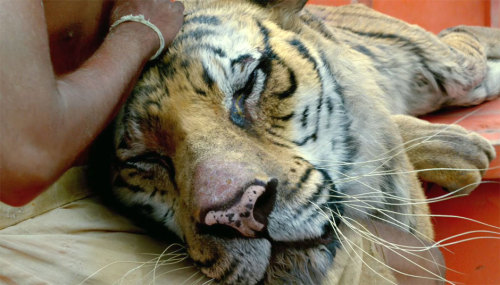
The festival opened with Ang Lee’s Life of Pi, the director’s most daring venture yet — dipping his toes in 3D technology and heavy CGI amidst the thematic density of Yann Martel’s novel. The business of Hollywood seems to have appropriated such technologies in a depressingly cynical way, going so far as to retrofit 3D onto films that were made to be seen in simply two dimensions just for the sake of maximizing their profits. But Ang Lee shows us the true potential of cinematic expression possible with these new means of filmmaking. As a spectacle, Life of Pi is unmatched. The height of the film is in the turning point of the ship sinking scene, which is equally harrowing and horrifying. The film swept me up and immersed me in a theatrical experience that I could feel would be remembered fondly in 10, 15, 20 years and forward as a moment of moviegoing marvel.
It’s what one might call an “event” film, the kind Hollywood executives try to put out each Summer to keep people wanting to see films in the theater rather than illegally streaming it to their laptop through the allure of 3D and/or IMAX projection. It’s the thrill of watching Paul Thomas Anderson’s The Master in 70mm and feeling like you’re watching a cinema in its purest form. But no director heretofore — not James Cameron, not Chris Nolan, not even Martin Scorsese — has felt out the potential for depth and spectacle with these tools more comprehensively that Ang Lee has here, not only advancing CG technology to new heights with the creation of the tiger but in cracking open new possibility for the future of film going into a digital age.
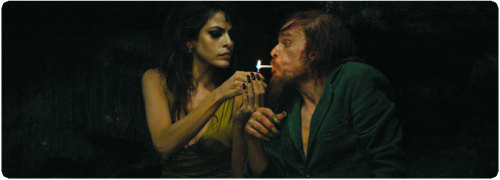
Also playing with the digital format, albeit begrudgingly, was Leos Carax’s return to filmmaking since Pola X in the 90s. Holy Motors opens with Carax himself awaking and entering a theater full of spectators as we enter his strange abstract world of a man with many worlds himself, a job of many occupations, and no shortage of faces to put on. It plays largely like a lament of this new age, between people’s abilities to be anyone they please through internet anonymity to intercuts of very early film yearning for a time when cameras were bigger than you (when now they’re smaller than your head, and everywhere you turn). Consistently mind-ripping sequences offer a feeling that they’re instantly iconic, tearing to shreds every standard of film you assume and creating a mad, nonsensical masterwork that keeps you at the edge of your seat for watching something exciting and new unfold in front of you. Sequences played out with a sense they’d instantly become iconic. You come to the safe conclusion that you never know what’s going to happen next, which is a feeling so fresh and so thrilling — to know you’re witness to a game changer. Jean-Luc Godard once noted that if cinema had never been invented, Nicholas Ray would have invented it. Suffice to say, I think the very same applies to Carax.
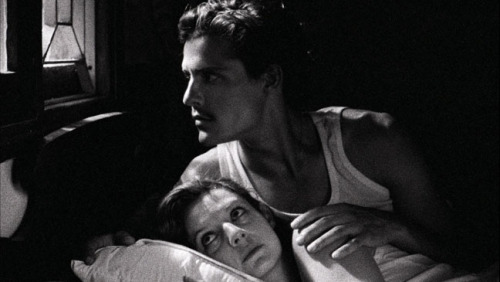
Perhaps the very finest film to screen at the festival was Miguel Gomes’ dreamily lovely Tabu. Gomes, working with film, actually uses the older tools at his disposal to paint a portrait of Western humanity between past and present, switching between 35mm and 16mm between the film’s two acts. The film in the present is in the more realistic (though black and white) 35mm print focusing on a present day woman in Lisbon whose elderly neighbor is nearing the end of her life with a maid hired by her daughter that she is deeply paranoid of. The film touches on social contexts explored in the second half of the woman’s earlier life in a Portuguese colony in Africa in grainy 16mm offering a dream-like reflection of a story that delves into unabashed melodrama that reflects on the past, its relevance to the present, and the general universality of human emotion. It works as engrossing entertainment as well as it does in its depths of commentary (pertaining to race, class, history, gender, age, etc.) and is a real achievement.
Also employing some old school film stock is Pablo Lorrain’s No, which looks like a 1980s home video cassette recording that Lorrain then brilliantly intercuts with actual archival footage looking very much the same. Documenting the “No” campaign in the 1988 Chilean plebiscite against General Pinochet, the film uses the actual television spots run on both sides and footage of protests that show the brutality of Pinochet’s regime — making so much more powerful the actual staged events of the film featuring a fine performance by Gael Garcia Bernal. The film’s fresh and fascinating use of cinema lends to a much more explicitly political message than that of Tabu, but the film is similarly so light-hearted and rather fun around its edges.
The films at this year’s festival ranged widely in genre, tone, style; some used digital, some used film. But they all unite in confirming the hope for the future of film — for its possibilities, its potential, its usefulness, and the value of still going to see movies like this in going forward. Many people seem confuse a lack of a clear future path with having no future at all. What is actually the case is something a lot more exciting, and a lot more fascinating than the more foreseeable path! People can make films at the palms of their hands and upload them to youtube. Amateurs like myself could access these works publicly and write up my own critiques of them. It can be argued, in fact, that we’re witnessing the dawn of a new emerging golden age of film. A golden age where everyday people from all around the world are creating new and interesting works of art with new and rapidly advancing formats and technologies that bring us well past the age of waving fire-lit torches across a simple painting to mimic the basic magic of a moving image, and into the 21st century with an evolving and expanding understanding of the cinematic form.
Read more!

Monday, October 10, 2011

My Week With Marilyn


First of all, the film itself is a lot better than I expected. Perhaps thin and a bit disposable like Me and Orson Welles a few years ago but I found this much more watchable overall and generally more convincing. It is definitely stagey and very old fashioned Hollywood in its construction but as appropriately as the film they're making in this film is very much the same.

Eddie Redmayne and Emma Watson are perfectly serviceable while Judi Dench plays the same lovable and sweet but still honest and wise old broad that she generally plays in her sleep. Julia Ormond was stunning as Vivien Leigh in her insecurities about her relationship with Olivier on the set of the film and in her starpower as she reaches 40, and I wish there were more of her since, frankly, she's barely in it.

The two stars are who you'd pretty much imagine. Now, let's get this out of the way. There were times in the film where Michelle's resemblance to Marilyn was straight up uncanny, but no, overall, she does not look all that much like her. But she didn't look more unlike her than Branagh did as Laurence Olivier in the same film. It didn't matter because at some point in the film I easily bought her as Marilyn, really capturing the full spectrum of enigma that exists in our image of her. Williams has that gift where one glance of her eyes could be of pain, disappointment, shock, overwhelming joy, flattering, etc. at different times. Your eyes go to her every moment she's onscreen, and really, I don't know any other actress who could have pulled off the performance with the same intelligence and emotional pull in spite of there being some who might just be considered more "conventionally" sexier than her (though remember, we're using our present day perception of such a thing which Monroe herself likely would not have fit).

She was excellent playing against Branagh, and it's interesting to note that Williams herself seems more of a method actress (and a very good one at that in addition to her natural beauty and allure that I think is part of the formula for the success of her performances) while Branagh is obviously more of Olivier's school. I don't know about the test screening reactions that suggest that Branagh totally outshines Williams in this; yes, he's given quite easily the very best lines of the entire movie that had me burst out cracking up in a way that I can't quite remember doing in a film in a very long time. Hits those RIGHT out of the park. But in the end it's true that Olivier's character is the actor who wants to be a star while Monroe was the star who wanted to be an actress, and her effortless starpower is what shone in this film.
Read more!

Sunday, September 26, 2010

NYFF Diaries: Poetry, and first weekend report card


At the risk of giving too much away about this wonderful flick, I've decided upon a tablet format for this review as well.

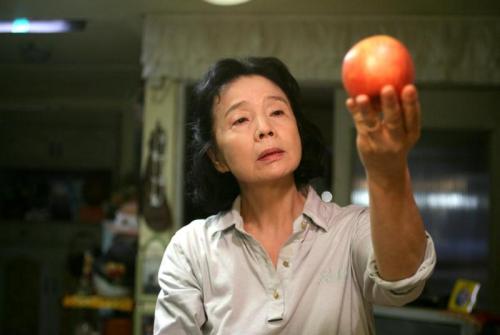
Poetry is a fascinating and often heartbreaking story focusing around an older woman desperate for fulfillment, vision, and control over her thoughts and memories. At the center of it is a behemoth of a performance by Jeong-he Yoon, displaying a brave vulnerability throughout with sensitivity and delicacy. Points of the film will have you feeling as light as a feather from its sheer loveliness, other points will have your jaw to the floor in disturbing disbelief. With a runtime of approximately two and a half hours, it did tend to cinematically ramble a bit in its last half hour where it got slightly distracted from the beautiful simplicity of the central and most interesting storyline, but it compensates with a final scene of pure visual poetry that rivals any film sequence since the new millennium.

Grade: A-

Which leaves us with these results after this first weekend of the New York Film Festival.

Of Gods and Men: C
Uncle Boonmee Who Can Recall His Past Lives: A+
Poetry: A-

Next up: Inside Job this Friday!
Read more!

NYFF Diaries: Uncle Boonmee Who Can Recall His Past Lives


Uncle Boonmee Who Can Recall His Past Lives, which enchanted Tim Burton's jury to a Palme D'Or win at this year's Cannes Film Festival, is a mystifying and exquisite crowning jewel on Thai director Apichatpong Weerasethakul's young career so far. From the opening long take of a water buffalo immersed in the luscious Thai forests, you get the sense that Weerasethakul's whole world is very much alive. Each leaf in his frame has a liveliness and spirit all its own.

When describing her experience viewing director Apichatpong Weerasethakul's first festival sensation, Tropical Malady, Tilda Swinton once said: "I actually remember rubbing my eyes with my fists...convinced, for one split second, that I fallen asleep, that only my unconscious could have come up with such a texture of sensation." Certainly dreamlike, Weerasethakul's sensory cinema is a very pure and transportative one; you feel very much apart of the Thai jungles. You feel yourself in its waters. Trapped in its caves.

We follow Uncle Boonmee in his twilight days with the utmost passion. His wife returns to him and her sister he lives with in the form of a ghost at the dinner table. The way he had missed his beloved wife for so long is heartbreaking to see play out on the screen. His son walks up in the form of some sort of monkey-ghost. Weerasethakul modeled him after the almost campy Thai television of his childhood where these sorts of figures were clearly men in monkey costumes, but it doesn't play nearly as cheaply in appearance or theme. We follow one of Boonmee's recollections as a catfish who had once made love to a human princess. I guarantee you that you will never see such a sequence in film made so naturally, made to seem so ordinary, and so believable. Weerasethakul's ode to Thai folklore never comes across as the least bit absurd or hard to take seriously.

We see Uncle Boonmee predicting a future life in Thailand, shot very reminiscently of La Jetée's nightmarish account of a similar future, ruled by a thought-controlling military and the more fashionable people turning away from the natural life of peace in the forests we have lived with the character throughout the film in favor of a crueler life of modernity in fashion and technology. Once Uncle Boonmee passes, we see a life without him where people are glued to their TV sets and obsessed with counting money.

The film is a floating world of fleeting beauty. A quiet meditation of a land past, present and future. Alive with the sounds of insects, of night, of rustling leaves. The beautiful cinematography can capture the richness of tress, the pristine water or the monotony of manmade walls at any given moment. It's a stunning achievement.

Grade: A+
Read more!

NYFF Diaries: Of Gods and Men


Left to Right: Jacques Herlin as Amédée and Michael Lonsdale as Luc
© Marie-Julie Maille / Why Not Productions, Courtesy of Sony Pictures Classics


Technically, SPC asked me to hold off publishing any proper reviews until the film's US release in February, so here's just a little tablet.

Of Gods and Men offers some interesting looks into a group of very Christian monks at the onset of Islamic fundamentalism beginning to take hold in the Middle East in 90s Algeria. A true story, director Beauvois offers thought pondering parallels to how the West should probably interact with the region through such turbulent times, offering messages of tolerance and education of Islam's more peaceful teachings. There were fascinating sequences that played out in the film, but they were put very few and far between tedious scenes of the monks' average everyday activities and the repetition of their standard protocol. Long stretches of largely uninteresting dialogue tried desperately to inject the screenplay's themes after the film had wasted much precious time with recounting very mundane daily lives of these monks, and ultimately made the film play out at an excruciating pace that made the two hours feel more like four to five.

Grade: C
Read more!

Sunday, September 12, 2010

NYFF Diaries


Bought the tickets today. Got to the box office way late though, so I have terrible seats but whatev. Also, the lady deprived me of seeing many more movies by insisting (falsely) that box seats aren't half off.

Saturday, September 25: Uncle Boonmee Who Can Recall His Past Lives (Apichatpong Weerasethakul)
Sunday, September 26: Poetry (Chang-dong Lee)
Friday, October 1: Inside Job (Charles Ferguson)
Sunday, October 3: Certified Copy (Abbas Kiarostami) and Aurora (Cristi Puiu)
Wednesday, October 6: Another Year (Mike Leigh)

The wait and anticipation for the last one is gonna be torturous. Read more!

Friday, August 27, 2010

NYFF: Tentative schedule

With a budget of $100 set, I'm going to see five films. As I see it, four of them are set in stone:

Uncle Boonmee Who Can Recall His Past Lives - Saturday, September 25th (3:00 pm)
Certified Copy - Sunday, October 3rd (11:30 am)
Aurora - Sunday, October 3rd (5:00 pm)
Another Year - Tuesday, October 5th (6:00 pm)

I'm pretty pumped for those. As for the last slot, I think I might try the route of "obstructed viewing" seats for half off to slip in two more movies, Poetry and Inside Job, to stick with my $100 budget. If not, I'll probably stick with Poetry. If any of them sell out, or something, my backup plans (besides the other two I mentioned) include My Joy, Of Gods and Men, Oki's Movie, and The Strange Case of Angelica. Word. Read more!